
AI agents
- AI agentsPost6 months ago @askalphaxiv
Recursive Multi-Agent Systems Refine Shared Latent States
The post describes a paper in which agents recursively refine latent thoughts and exchange hidden states, decoding text only at the end. It says experiments found more accurate collaboration, faster execution, and lower token use.
The approach explores whether latent-state communication can improve multi-agent collaboration while reducing token use.
Agentic Harness Engineering for Coding Agents
The paper introduces a framework for automatically evolving coding-agent harnesses using observable components, condensed trajectory evidence, and decisions tested against task outcomes. It reports Terminal-Bench 2 pass@1 rising from 69.7% to 77.0% over ten iterations.
The approach makes harness changes easier to evaluate, attribute, and revert.
PARE-Bench evaluates proactive agents in stateful app simulations
PARE models applications as finite state machines to simulate active users. PARE-Bench includes 143 tasks across communication, productivity, scheduling, and lifestyle apps, testing goal inference, intervention timing, and multi-app orchestration.
It offers engineers a benchmark for evaluating agent behavior across stateful, sequential user interactions.
StructMem adds temporal structure to LLM agent memory
The StructMem paper proposes a hierarchical memory system for long-term conversational agents. It aims to capture relationships between events for temporal reasoning and multi-hop question answering, balancing flat memory’s efficiency against the construction costs of graph memory.
Engineers building long-horizon agents can assess an approach to preserving event relationships without relying on costly graph construction.
TACO learns context compression rules for terminal agents
TACO is a framework that discovers and refines context compression rules from terminal-agent interaction trajectories. The paper reports tests on TerminalBench, SWE-Bench Lite, and CompileBench.
Engineers building long-horizon terminal agents can explore an approach to reducing noisy observations in context.
- AI agentsArticle
Weekly AI research roundup includes several agent papers
The roundup lists research on Claude Code’s agent-system design, long-horizon engineering and task scaling, and memory transfer in coding agents, alongside work on distillation and other topics.
It offers leads on agent design, memory, and coordination for engineers tracking current research.
Protocol for auditable self-improving agents
The post describes a paper proposing a protocol for agents to propose, assess, and commit improvements, with auditable lineage and rollback.
The framework’s audit and rollback mechanisms are relevant to engineers designing self-improving agent systems.
- AI agentsPaper
AutoSOTA automates iterative AI model improvement
AutoSOTA is an end-to-end system that uses eight specialized agents to reproduce and improve models from AI papers. The post reports 105 new state-of-the-art models across LLMs, computer vision, and time series.
It offers an example of multi-agent orchestration for research workflows involving code, experiments, and model refinement.
ML-Master 2.0 uses layered memory for long-horizon research
The post describes ML-Master 2.0’s Hierarchical Cognitive Caching: short-, medium-, and long-term memory for research across experiments and sessions. The team reports a 56.44% medal rate on MLE-Bench after a 24-hour run.
The layered memory design offers a concrete approach to managing agent state across extended research tasks.
- AI agentsProject
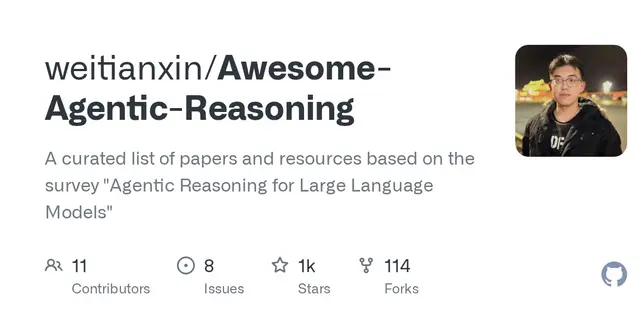
Curated papers and resources on agentic reasoning
A GitHub list of papers and resources based on the survey “Agentic Reasoning for Large Language Models.”
Useful for engineers looking for research and resources on reasoning in AI agents.
- AI agentsPaper
Controlled Self-Evolution for Algorithmic Code Optimization
The paper proposes Controlled Self-Evolution, which uses diverse initial strategies, feedback-guided mutations, and cross-task experience to improve algorithmic code through iterative evolution. It evaluates the approach on EffiBench-X.
Its approach to exploration, feedback, and cross-task memory offers concrete design ideas for coding agents.
- AI agentsPost10 months ago @HuggingPapers
Microsoft releases 14B FrogMini coding agent
The post says Microsoft released FrogMini on Hugging Face, a 14B coding agent scoring 45.3% on SWE-Bench Verified. It describes a training approach in which agents unintentionally break tests while adding features.
The reported benchmark result and training approach may be relevant when evaluating coding agents.
MemRL learns agent memory utility through runtime reinforcement learning
MemRL is a non-parametric approach that applies reinforcement learning to episodic memory, aiming to help agents learn from experience without changing LLM weights.
It explores ranking relevant memories by learned utility rather than semantic similarity alone.
- AI agentsProject
Use a stop hook to keep Claude running
The post points to Anthropic’s Ralph Wiggum plugin and describes using a stop hook to prompt Claude to continue when it stops.
Stop hooks can help engineers orchestrate longer-running agent work.
Agent-R1: Modular RL for Multi-Turn LLM Agents
Agent-R1 is a framework for training LLM agents with end-to-end reinforcement learning across multi-turn interactions. The paper focuses on agents that use tools and interact with environments over multiple rounds.
It addresses how to train agents for sequential tool use and interaction with environments.
- AI agentsPost10 months ago @YuxiangWei9
Self-play RL for software bug injection and repair
The post introduces Self-play SWE-RL (SSR), a method for training one LLM agent to alternate between injecting and repairing bugs in real-world repositories, without human-labeled issues or tests.
The approach may interest engineers exploring ways to train coding agents without labeled issue and test data.
- AI agentsPaper
PasoDoble uses dual-play to train LLM reasoning
The paper presents dual-play, an adversarial learning framework that assigns two models specialized roles to reduce reliance on external supervision. One model creates questions and the other solves them.
Engineers can explore an approach to training LLM reasoning through competition between specialized models.
- AI agentsPaper
ReCode unifies planning and action for LLM agents
ReCode is a paradigm that uses recursive code generation to unify planning and action, letting agents adjust decision granularity. Its paper argues that rigidly separating high-level planning from low-level action limits LLM agents.
The approach offers a way to build agents that shift between strategic planning and fine-grained actions.
- AI agentsPaper
A Predictive Model for Scaling Agent Systems
The paper introduces quantitative scaling principles that model how agent-system performance varies with coordination, model capability, and measurable system and task factors. It evaluates 260 configurations across six agentic benchmarks and five architectures.
Engineers can use the work to reason about how coordination and model capability affect agent-system performance.
Engineer critiques an AGI paper’s definition and benchmarks
The post discusses a paper that defines AGI as replicating a model of human cognition and tracks metrics over time. The author praises its discussion of capability variation and criticizes its benchmarks and narrow view of AI.
It highlights design choices in AGI definitions and evaluations that engineers may want to scrutinize.
 arxiv.org