
AI agents
- AI agentsProject
Running isolated LM experiments with Codex CLI config to disable tool-calling
A post advising how to run isolated experiments with local models via Codex CLI, using config files that disable tool-calling so results stay shareable. It links to a config file in the lm_understand-logs repository.
Shows a reproducible harness setup for evaluating local models without tool access confounding results.
AWS open-sources agent runtime claiming 75,000 concurrent agents in 8GB RAM
Per the author, AWS open-sourced a runtime that saves agent state and suspends agents while they wait for tools, resuming them on events. The post claims 75,000 concurrent agents fit in 8GB of RAM; no link is included.
Suspend-and-resume agent state is a concrete design pattern for cutting memory cost of tool-using agents at scale.
- AI agentsProject
Stealth Browser MCP: browser automation for AI agents over MCP
Open-source repo offering stealth browser automation for AI agents over MCP and the Chrome DevTools Protocol, with navigation, network hooks and DOM extraction. The author says it bypasses Cloudflare challenges.
Shows how agents can drive real Chrome sessions via MCP, which raises bot-detection trade-offs.
- AI agentsProject
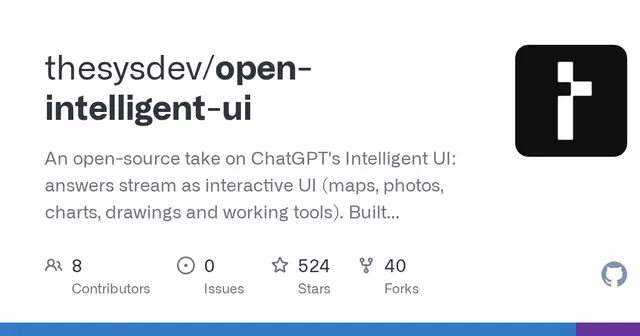
Open-source project generating interactive chatbot UI with OpenUI
An open-source GitHub project that streams chatbot answers as interactive UI such as maps, charts, tables and working tools, built with OpenUI and usable with models from OpenRouter and Ollama.
Shows a concrete pattern for agents returning live UI components instead of plain text replies.
Agentic Economies for Autonomous Scientific Discovery
A new arXiv paper argues that autonomous science is limited by physical validation capacity, not just AI capabilities. It proposes designed markets and institutions to allocate scarce validation work.
It frames multi-agent research systems around resource allocation and validation bottlenecks, not only reasoning ability.
Paper on self-improving coding agent harnesses
A social post recommends an arXiv paper to engineers building coding agent harnesses, suggesting agents could use it to improve themselves. The preview contains no further details about the paper's content.
It points to a research paper on improving coding agent harnesses, a core agent-engineering topic.
HERMES: component-level LLM harness for repository-scale software tasks
An arXiv paper proposing HERMES, a harness where each repository component has a resident LLM that knows its code. The authors report gains on migration and four SE benchmarks versus matched baseline harnesses.
Shows harness design, not just model choice, can drive large gains on long-horizon coding agent tasks.
- AI agentsPost1 month ago @rohanpaul_ai
DeLM: decentralized shared-context multi-agent coding system
Stanford paper presenting DeLM, which replaces a central coordinator with shared context and a task queue for coding agents. Reported by the author to be up to 2.49× faster and more accurate than Claude Code and Codex baselines.
Shows an alternative to central orchestration for long-horizon coding agents, with open code and trajectories.
VeriHarness verifies agent rollouts for long-horizon tasks
The paper introduces VeriHarness, which uses a fixed base model to verify agent claims without reference answers or grading rubrics at test time. It checks disputed claims against workspace evidence and challenges claims shared by all rollouts.
It offers an approach to catch shared errors and resolve disagreement when selecting agent outputs.
- AI agentsPaper
Multi-Head Recurrent Memory Agents for Long Context
The paper identifies retention as a bottleneck in recurrent memory agents and presents a training-free approach that selects one memory head while preserving the others.
Engineers building long-context agents can evaluate a memory strategy that does not require training.
- AI agentsProject
NVIDIA OpenShell is a runtime for autonomous AI agents
OpenShell is a GitHub project described as a safe, private runtime for autonomous AI agents.
Engineers building autonomous agents can review a runtime focused on safety and privacy.
- AI agentsArticle
JAZ explores a minimalist recursive agent framework
The post describes JAZ as using a single recursive code primitive for agent loops. It claims JAZ can outperform Letta and ACE at lower cost; the linked preview describes agents using tools and alternating through a workflow.
The comparison may help engineers assess whether simpler agent loops can replace specialized memory and self-improvement frameworks.
JAZ uses a minimal, code-driven agent harness
JAZ is an agent framework with a single `invoke` primitive; the LLM writes code that can call it recursively. The post reports results on StuLife and AppWorld, including lower costs than the compared approaches.
The framework explores implementing memory and self-improvement within the agent loop instead of as separate subsystems.
- AI agentsPaper
Ablations of Coding Agent Harnesses
The paper reports 176 ablation setups across SWE-Bench and Terminal-Bench. The post says rule-based context trimming with a short summary outperformed elaborate recovery, while explicit planning helped weaker models but not frontier models’ success rates.
Its ablations can help engineers assess which harness components improve agent performance or reduce costs.
DeepSeek describes DSec sandbox infrastructure for agent training
The DSec paper describes elastic, stateful execution environments for large-scale agent training and evaluation, including varied isolation needs and bursty sandbox creation. The post also reports defenses against agents exploiting their training environments.
Sandbox design affects the scale, efficiency, and security of agent training and evaluation.
Agora uses Git as shared memory for research agents
Agora stores agent contributions in an append-only Git DAG, with links to prior work and searchable views of results and verification status. In a nearly 12-day run, 13 LLM workers made 1,703 contributions to initialize a hybrid model without training data or gradient updates.
The design offers a concrete way for parallel agents to share verified results and avoid repeating experiments.
- AI agentsProject
DeepSeek Harness adds browser and computer-use options
DeepSeek Harness v0.1.6-alpha.1 adds a Web sidebar with persistent multi-tab terminals and MCP resource support. Experimental browser use supports Playwright MCP, Chrome DevTools MCP, and Stagehand; computer use supports Cua Driver MCP or a native driver.
The release expands available interfaces for agents that need to use browsers, terminals, and local computers.
- AI agentsProject
Tencent Cloud’s Octop is a self-hosted, multi-user agent platform
Octop is an open-source, self-hosted AI assistant platform described as supporting multiple users and agents. The post says it stores data locally in SQLite and integrates with chat platforms, ACP, browser automation, and terminal assistance.
Engineers can evaluate how Octop combines local storage, team access, messaging integrations, and agent tools.
Byte Models’ Scaling Trends Compared with Token Models
The paper studies distilled byte and token models at scales up to 1 trillion training bytes. It introduces approximate and exact methods for converting token logits into byte logits and reports that byte models reach a higher ceiling as compute grows.
The results may help engineers weigh tokenization choices and distillation methods when scaling language models.
- AI agentsPaper
Scientific Agent Skills: 163 Research Procedures Across 16 Fields
The paper presents an open library of 163 procedures for research agents across 16 areas, including genomics, cheminformatics, medical imaging, and study design. It focuses on procedural choices needed for defensible analyses.
Engineers building research agents can use the library as a reference for domain-specific procedures and caveats.
 arxiv.org