
AI agents
- AI agentsPaper
A study of data, algorithms, and reasoning modes for agentic RL
The paper investigates agentic reinforcement learning across data, algorithm design, and reasoning modes. It reports findings on trajectory data and tool use, and links to an open-source repository.
The study may help engineers make design choices when training LLM agents for reasoning and tool use.
- AI agentsPost1 year ago @alex_prompter
TUMIX uses diverse agents to refine answers at test time
The post describes TUMIX, a system where agents using different tools solve problems independently, share answers, and refine them over several rounds. It claims diverse agents outperform copies of one model and improve Gemini-2.5 results.
The approach highlights agent diversity and coordination as ways to improve reasoning without retraining the base model.
- AI agentsPost1 year ago @iScienceLuvr
Early experience for agent learning
The post describes early experience: using future states from an agent’s own interactions as supervision without reward signals. It examines implicit world modeling and self-reflection as two strategies.
The approach targets learning challenges in environments with unverifiable rewards or costly long-horizon rollouts.
- AI agentsPost1 year ago @rohanpaul_ai
ToolUniverse connects LLMs to research tools
ToolUniverse proposes a shared interface for discovering and calling research tools, with support for local tools and remote tools using MCP. The post describes a library of 600+ tools and a drug-discovery demonstration.
A shared discovery and execution interface could reduce the need for one-off integrations in research workflows.
- AI agentsArticle
Stanford course covers self-improving AI agents
Stanford’s CS329A course, “Self-Improving AI Agents,” includes AB-MCTS, The AI Scientist, and the Darwin Gödel Machine, according to the post.
The course brings together work on self-improving agents that engineers can explore.
- AI agentsArticle
Meta releases 32B open-weights Code World Model
Meta describes Code World Model (CWM), a 32-billion-parameter open-weights LLM released for research on code generation with world models.
Engineers can examine an open-weights model aimed at code-generation research with world models.
- AI agentsPost1 year ago @arankomatsuzaki
LIMI studies data curation for agent autonomy
The post describes LIMI, which uses 78 curated demos and reports 73.5% on AgencyBench, outperforming models trained on 10,000 samples. It argues that strategic curation, rather than data scale, drives autonomy.
The reported results raise a testable question about how training-data curation affects agent benchmark performance.
- AI agentsPost1 year ago @rohanpaul_ai
Theory-Grounded Prompts for Generalizing Social Agents
The post describes an MIT study that uses behavioral theory to write agent prompts, tunes them on small human datasets, and validates them on related but distinct settings. It reports lower prediction error on new game variants than language-model and equilibrium baselines.
Cross-setting validation offers a way to test whether social agents generalize beyond their tuning data.
- AI agentsPaper
SFR-DeepResearch trains single agents for research tasks
The paper presents RL-trained autonomous agents for deep research that use web search, browsing, and Python. The agents can summarize prior results when context is limited.
It describes an approach to tool use, long-horizon memory, and end-to-end RL for research agents.
- AI agentsPost1 year ago @rohanpaul_ai
NVIDIA’s Universal Deep Research runs research strategies as code
The system compiles natural-language research strategies into a generator function that calls search and an interchangeable LLM. It stores intermediate facts in named variables and runs strategies in a sandbox.
Engineers can inspect and customize research control flow, model use, and source rules rather than relying on a fixed workflow.
- AI agentsPost1 year ago @jiqizhixin
RLVMR Adds Process-Level Rewards to Agent Training
Tencent researchers propose RLVMR, which combines outcome rewards with supervision for steps such as planning, exploration, and reflection. A 7B agent reportedly scored 83.6% on the toughest unseen ALFWorld and ScienceWorld tasks.
Process-level rewards may help engineers train agents to reduce redundant actions and recover from errors.
TheAgentCompany Benchmarks Agents on Real-World Tasks
TheAgentCompany is a benchmark for evaluating AI agents on consequential tasks spanning software development, project management, administration, and data science.
It offers engineers a benchmark for assessing agent performance across varied work tasks.
- AI agentsPost2 years ago @eshorten300
ADAS Uses Search to Design and Evaluate Agentic Systems
Automated Design of Agentic Systems (ADAS) uses Meta Agent Search to propose agents from a domain description, framework code, output instructions and examples, and an archive of discovered agents. New agents are evaluated and added to the archive; the framework was tested on several reasoning…
The iterative archive-and-evaluation process is relevant to engineers exploring automated agent design.
- AI agentsPost2 years ago @rohanpaul_ai
AutoToS Refines Search Components With Tests and BFS
AutoToS iteratively refines generated successor and goal-test functions using unit-test feedback. It also checks them in a breadth-first search on example problems.
The process shows how tests and search-based checks can guide automated refinement of generated components.
- AI agentsProject
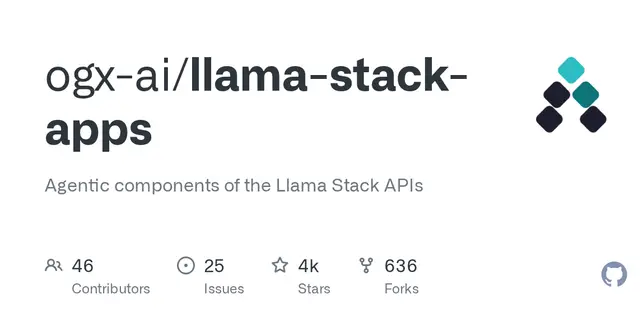
Agentic components for Llama Stack APIs
The GitHub repository contains agentic components of the Llama Stack APIs. The post highlights using Tools and Functions with Llama 3.1 models.
A relevant starting point for engineers exploring tool and function use in Llama Stack.
 arxiv.org