
AI agents
Alibaba’s Zvec Team Releases Local Search Tool zg
Alibaba’s Zvec team says it open-sourced zg, a local search tool for developers and AI agents. It combines semantic, BM25, hybrid, and rg search and works with popular agents.
Engineers building agents can consider a local tool that brings several search modes together.
- AI agentsPost2 months ago @rohanpaul_ai
Reliability checks reduce errors in AI-generated research papers
The post describes an arXiv paper reporting severe result hallucinations in papers produced by Agent Laboratory and Co-Scientist when reliability modules were removed. Checking manuscript claims against execution logs reduced the reported rate to 4%.
It highlights the value of validating agent-generated research against execution evidence.
WikiSkill Uses Persistent Knowledge to Evolve Agent Skills
WikiSkill separates execution traces, a persistent knowledge wiki, and executable skills. It consolidates experience in the wiki, which informs later skill updates.
The approach offers a way to reuse agent experience across skill iterations rather than relying on scattered optimization histories.
JIT-Agent Generates Task-Adaptive Agent Harnesses
JIT-Agent synthesizes agent harnesses on the fly for off-the-shelf agentic LLMs. Its four-module protocol covers memory, planning, action protocols, and tool orchestration; it can also repair and evolve harnesses.
The paper explores automating harness design and adaptation, including components engineers often build and maintain manually.
- AI agentsPaper
Recuris evolves agent memory around a frozen LLM
Recuris describes two loops for long-horizon agents: working and experiential memory guide task execution, while a fixed meta-agent analyzes execution traces and proposes targeted memory repairs.
It explores improving agent behavior through memory and execution feedback without changing model weights.
- AI agentsProject
Code Notebooks for Agentic Design Patterns
Antonio Gulli's guide covers prompt chaining, routing, reflection, tool use, planning, and multi-agent systems, with code notebooks for hands-on exploration.
Engineers can use the notebooks to explore common agent design patterns in code.
Scroll manages long-horizon agent context as an executable environment
Scroll pairs an append-only event log with a sandboxed, persistent Python kernel. Agents can search and transform session state, while an eviction index links compact landmarks to recoverable log entries.
The design offers an alternative to committing long-running agent history to a fixed compressed memory representation.
Active Inference for Agent Context Acquisition
The paper models how interactive agents choose between acting on assumptions and spending resources on clarifying questions, retrieval, or other context-gathering actions. It frames these choices as active inference over a latent task state, with costs included in the objective.
The framework gives engineers a way to reason about when an agent should gather more context instead of acting on uncertain assumptions.
- AI agentsPost2 months ago @rohanpaul_ai
Pandora’s Router Uses Cost-Aware Model Selection
The paper frames model routing as a Pandora’s Box problem: it uses cheap, noisy scores, then pays for stronger estimates when their expected value exceeds their cost. On MATH, RAG, and EmbedLLM, it had the lowest or tied-lowest average combined routing regret and inspection cost across tested…
Engineers building model routers can compare the approach’s tradeoff between estimation cost and routing regret.
- AI agentsPost2 months ago @rohanpaul_ai
AI R&D agents rarely revisit their training strategy
A study of 1,338 post-training trajectories found agents rarely changed high-level training strategy: 74 of 3,557 adjacent experiments did. Journals, skill libraries, and evaluators improved benchmark scores but did not trigger strategy changes.
Agent workflows may need explicit triggers to reconsider the overall strategy, not just refine its implementation.
- AI agentsPost2 months ago @rohanpaul_ai
AgentSysBench Studies Serving Bottlenecks in Agent Workloads
The paper introduces AgentSysBench, covering 10 agentic applications, and reports that model inference is often not the main serving bottleneck. It evaluates task-aware serving, communication-aware placement, state offloading, and caching.
The results suggest agent serving systems may need to optimize models, tools, memory, and communication together.
DSH post reports a shell prompt mismatch causing command delays
The author says DSH’s terminal-bash and tool-bash-persistent use different prompt strings, triggering a 3.5-second timeout. They report changing the prompt constant reduced a test command’s latency from 3,600 ms to 158 ms.
The reported prompt mismatch may help engineers diagnose slow shell commands in DSH.
- AI agentsArticle
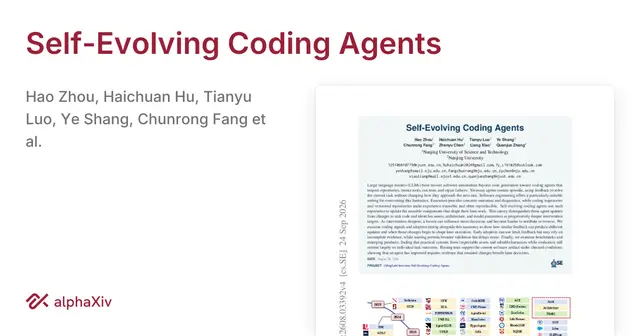
Survey of Self-Evolving Coding Agents
The survey reviews systems that learn from software-development interactions and use those lessons to modify their memories, workflows, tools, or model parameters. It covers 108 systems.
It maps ways coding agents can adapt using lessons from prior development work.
- AI agentsArticle
Benchmark compares seven self-hosted memory providers for Hermes Agent
A community benchmark compares seven self-hosted memory providers for Hermes Agent. Each was tested with the same 71,060 conversation turns and 3,750 questions about facts that change over time.
The comparison offers evidence for engineers choosing a memory provider for Hermes Agent.
- AI agentsArticle
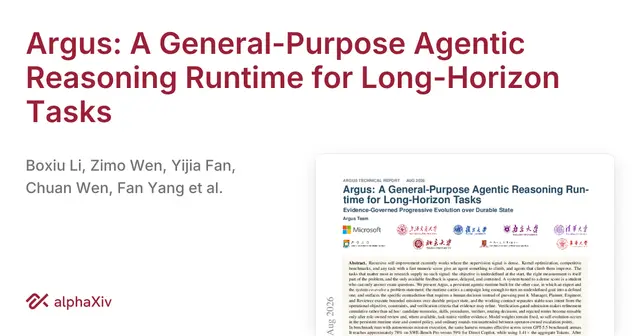
Argus uses a verification-gated runtime for long-horizon agents
Argus is a general-purpose agentic reasoning runtime for long-horizon tasks with underdefined objectives and sparse feedback. The post says it makes pivots verification-gated and reports 78% on SWE-Bench Pro versus 59% for Direct Copilot.
Engineers building long-running agents can examine how verification gates runtime state changes.
- AI agentsProject
Semantica builds graph-native infrastructure for AI agents
Semantica is an open-source project for turning data into knowledge graphs and recording agent decisions for later tracing. The post describes it as self-hosted and MIT-licensed.
Decision traces and provenance can help engineers inspect how an agent reached an outcome.
- AI agentsProject
Buzz publishes a memory specification
Buzz’s NIP-AE document specifies its memory feature. The project says formal writeups are intended to make features implementable and interoperable.
A formal memory spec can help engineers understand and interoperate with Buzz’s agent memory design.
- AI agentsPost3 months ago @HuggingPapers
Survey of Self-Improvement in Agentic Systems
A survey of 239 papers on how AI agents self-improve by updating the model or the scaffold, including prompts, memory, and tools.
It maps approaches to improving agents across both model updates and the systems built around them.
- AI agentsPaper
HarnessBank for self-evolving agent harnesses
HarnessBank is a method for evolving agent harnesses, including prompts, tools, and control loops. It uses semantic gene-bank search with gated verification to address greedy candidate selection and noisy self-generated feedback.
It describes an approach to improving agent performance by changing the harness around the model.
MemoHarness adapts agent harnesses using execution history
MemoHarness edits six harness surfaces and retrieves lessons from similar past cases to adapt to new ones. On a shell-agent benchmark, it scores 0.806 versus 0.722 for the strongest fixed-harness baseline.
It explores a way to improve agent control layers from their own executions without test-time labels or extra search.
 arxiv.org