


edu-chem-reaction
wy51ai/edulab · skills.sh
Open source Repository Open in the app JSON README (API)
About
Skill publicada por wy51ai/edulab no skills.sh. Instale com: npx skills add wy51ai/edulab@edu-chem-reaction
Details
- Kind
- Agent skills
- Publisher
- wy51ai
- Origin
- skillssh
- Category
- ferramentas
- Stars
- 1,348
- Forks
- 274
- Open pull requests
- 4
- Last push
- 2026-09-28T12:15:17Z
- Repository state
- ativo
- Language
- HTML
- License
- Apache-2.0
- Added
- 2026-10-06 04:49:34
- Updated
- 2026-10-06 04:49:34
- Origin id
wy51ai/edulab/edu-chem-reaction
README
# edulab
[简体中文](https://github.com/wy51ai/edulab/blob/HEAD/README.zh-CN.md) · **English**
A collection of education skills that turn academic problems into **interactive lesson web pages** and **narrated explainer videos**.
## Install
**Recommended** — install with [skills](https://github.com/vercel-labs/skills) in one command:
```bash
npx skills add wy51ai/edulab
```
To update to the latest version later:
```bash
npx skills update
```
> **Note:** `npx skills update` only refreshes skills you've **already** installed — it does **not** pull in skills newly added to the repo. When this repo gains a new skill (e.g. a new `edu-*`), run `npx skills add wy51ai/edulab` again to install it.
Or use it as a Claude Code plugin marketplace:
```
/plugin marketplace add wy51ai/edulab
/plugin install edulab
```
Once installed, the skills activate on their trigger words, and can also be invoked manually.
## Skill: edu-solid-geometry
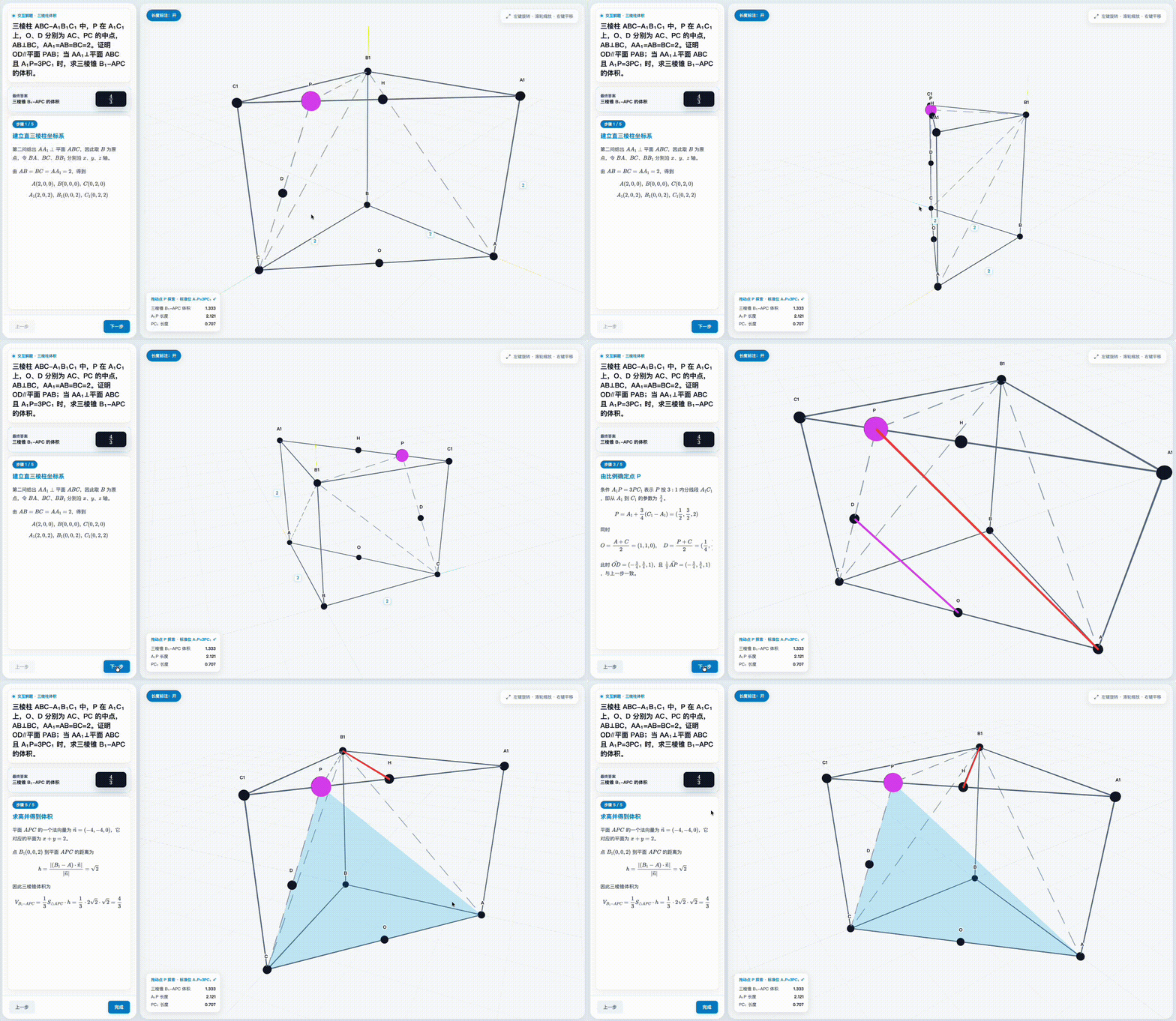
Solves one solid geometry problem into a self-contained interactive lesson page. Three entry points:
| Entry point | What it does |
|---|---|
| Text problem | Extracts the statement and solves directly |
| Image upload | Reads the problem from the image via vision, echoes it back for confirmation, then solves |
| Random problem | Solves with random parameters; re-rolls if the answer isn't clean |
**Problem types covered**: line-plane angle, dihedral angle, angle between skew lines, point-to-plane distance, volume, and more — on cubes / cuboids, pyramids / prisms, cylinders / cones. All solved uniformly via the "coordinate system + vector method."
**Trigger words**: solid geometry, line-plane angle, dihedral angle, angle between skew lines, distance to plane, interactive geometry solution page; 立体几何、线面角、二面角、异面直线、点到平面距离、正四棱锥、解这道几何题、随机出一道立体几何题、这张图里的立体几何题, etc.
### Dependency
The compute core `lib/geometry_kernel.py` depends on **sympy**. Use any `python3` that can import sympy:
```bash
python3 -m pip install sympy # if sympy is missing
```
### Generate from the command line (without Claude)
```bash
cd skills/edu-solid-geometry
python3 scripts/generate.py cube ./cube.html # cube · line-plane angle
python3 scripts/generate.py box ./box.html # cuboid · volume
python3 scripts/generate.py random 7 ./random.html # random problem (seed=7)
python3 lib/geometry_kernel.py # kernel built-in self-check
```
> If you don't pass an output path, it writes to the **current working directory (cwd)**.
## Skill: edu-analytic-geometry
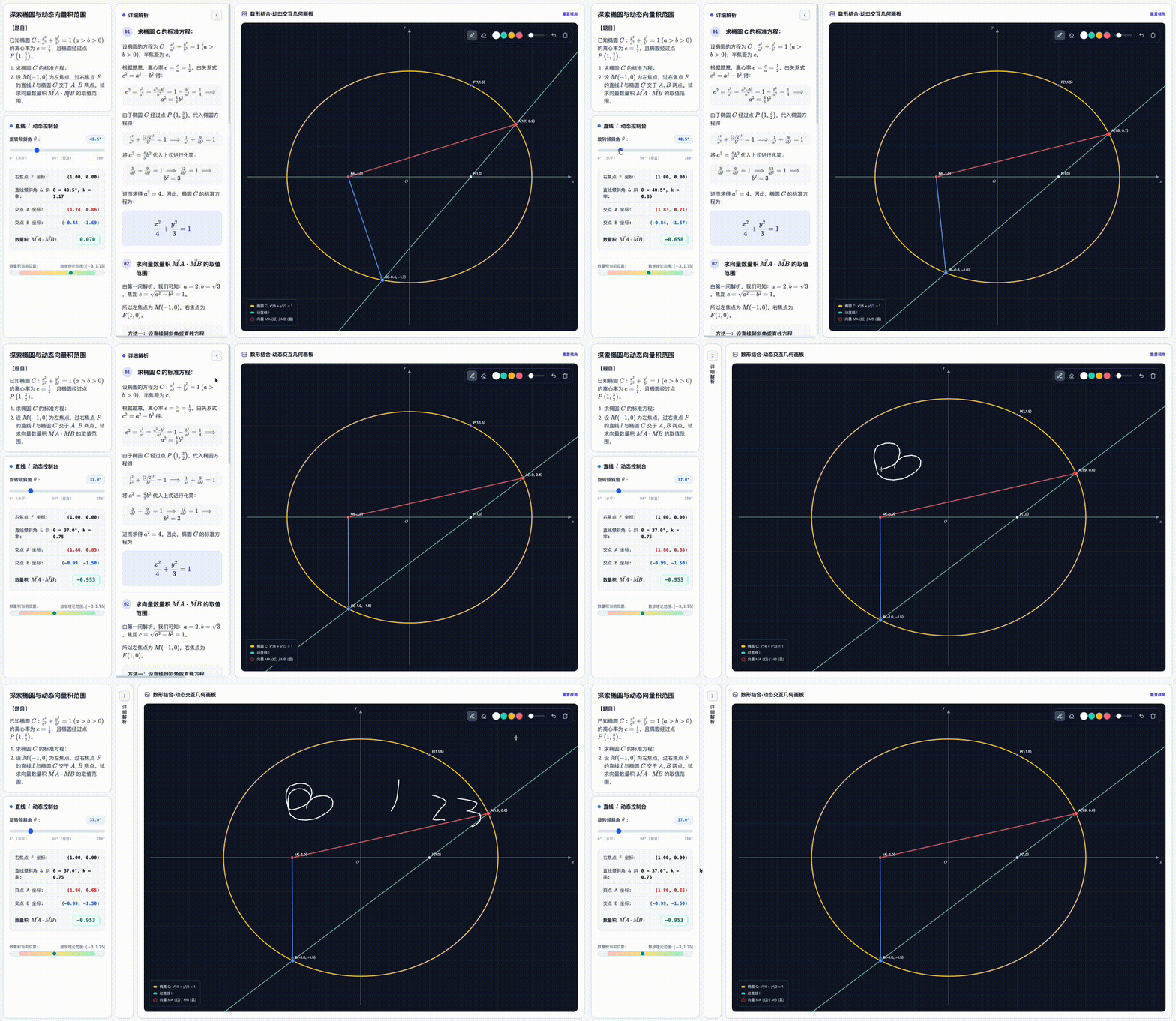
Solves one analytic geometry (conic sections) problem into a self-contained interactive lesson page. Same three entry points as above (text / image / random). Built on a **2D Canvas board + KaTeX** with a generic, data-driven interactive engine: a parameter slider drives derived constructions (line∩conic, point-on-conic, central reflection, tangent…) and live readouts, with a theoretical-range bar or a fixed-value indicator.
**Problem types covered**: standard equation, chord length, dot-product range / fixed value, triangle-area extremum, fixed point, fixed value (slope product), locus, tangent, eccentricity — on ellipses / hyperbolas / parabolas / circles. All solved uniformly via "parametrized line `x = my + c` + system + Vieta's formulas + substitution."
> A correctness note baked into the kernel: open/closed interval endpoints are decided by whether a *real* line attains them, so the boxed answer always matches what the interactive tool shows (e.g. the ellipse `MA·MB` range is the **closed** `[-3, 7/4]` — slide θ to 0° and you read exactly −3).
**Trigger words**: analytic geometry, conic sections, ellipse, hyperbola, parabola, chord length, dot product range, fixed point, fixed value, locus, eccentricity, interactive analytic geometry solution page; 解析几何、圆锥曲线、椭圆、双曲线、抛物线、焦点弦、向量数量积取值范围、定点问题、定值问题、斜率之积、三角形面积最值、轨迹方程、离心率, etc.
### Dependency
The compute core `lib/analytic_kernel.py` depends on **sympy** (same as above).
### Generate from the command line (without Claude)
```bash
cd skills/edu-analytic-geometry
python3 scripts/generate.py list # list registered problem types
python3 scripts/generate.py ellipse_dot_range ./sol.html # ellipse · MA·MB range [-3, 7/4]
python3 scripts/generate.py parabola_dot_const ./sol.html # parabola focal chord · OA·OB ≡ -3
python3 scripts/generate.py all ./out_dir # all registered types
python3 lib/analytic_kernel.py # kernel built-in self-check
```
> Like above, no output path → writes to the **current working directory (cwd)**.
## Skill: edu-chem-reaction

Turns one chemical reaction into a self-contained **microscopic 3D demonstration** page: an interactive Three.js molecular animation (drag the slider to watch bonds break / form and atoms recombine, with step highlighting) next to the KaTeX equation, step-by-step narration, an atom-conservation counter, and an optional energy–reaction-coordinate curve. Same three entry points (text / image / random).
**Two engines, auto-selected** — one renderer with two per-frame position resolvers, sharing the bond-diff drawing, labels, overlays and UI:
| Engine | For | Emphasizes |
|---|---|---|
| morph | combustion, combination / decomposition / displacement, redox | atoms fly to new partners — atom conservation & recombination |
| mechanism | organic mechanisms (esterification…) with catalyst · transition state · leaving groups | rigid fragments move through keyframes — the mechanism |
**sympy-driven correctness**: auto-balances the equation (integer coefficients from the matrix null space), validates the atom map (a bijection between reactant and product atoms) and conservation, and derives which bonds break / form from the before↔after difference — equation, geometry and counters all share one source.
**Hybrid geometry**: a built-in VSEPR molecule library by default; if RDKit is installed it can build conformers from SMILES (never installs it automatically).
**Reactions covered**: methane / hydrogen combustion, water electrolysis, Na + Cl₂ redox (with an electron-transfer overlay), glucose aerobic oxidation, and the esterification mechanism — spanning junior-high basics, senior inorganic redox, and organic mechanisms.
**Trigger words**: chemistry reaction, microscopic / molecular animation, combustion, electrolysis, redox electron transfer, esterification mechanism, bond breaking and forming, atom conservation, balance equation, interactive chemistry reaction page; 化学反应、微观演示、分子动画、燃烧、电解水、氧化还原、电子转移、酯化反应、断键成键、原子守恒、化学方程式配平 etc.
### Dependency
The compute core `lib/reaction_kernel.py` depends on **sympy** (same as above). **RDKit is optional** — used only if already installed, never installed automatically.
### Generate from the command line (without Claude)
```bash
cd skills/edu-chem-reaction
python3 scripts/generate.py list # list registered reactions
python3 scripts/generate.py combustion_ch4 ./reaction.html # methane combustion (morph · flame)
python3 scripts/generate.py esterification ./reaction.html # esterification (mechanism · catalyst)
python3 scripts/generate.py random 7 ./random.html # random reaction (seed=7)
python3 lib/reaction_kernel.py # kernel built-in self-check
```
> Like above, no output path → writes to the **current working directory (cwd)**.
## Skill: edu-math-video
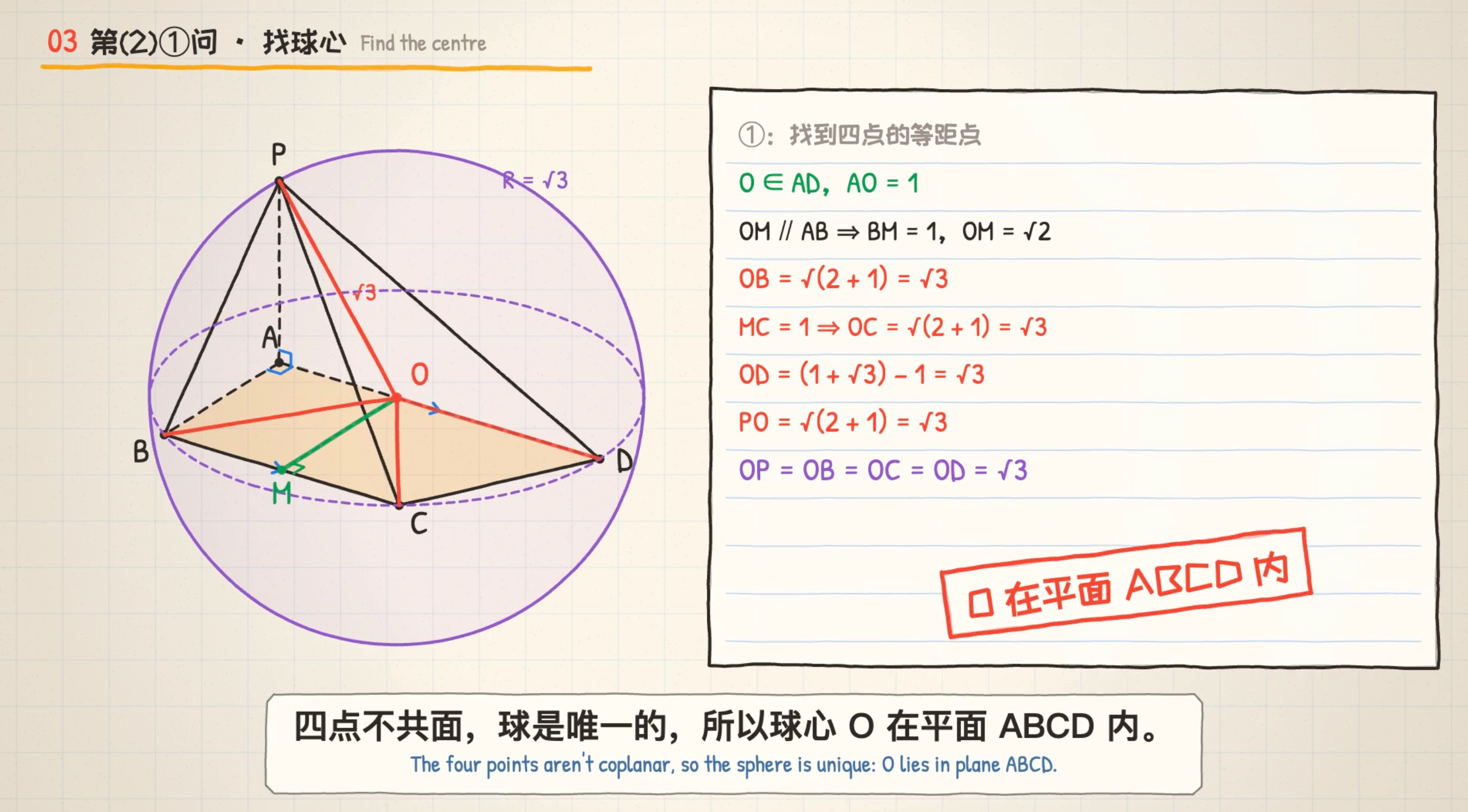
Turns one math problem (geometry, algebra, functions, motion problems…) into a **16:9 1920×1080 explainer MP4**: Chinese voice-over (Zhipu **GLM-TTS**), bilingual zh + en subtitles (`.srt` too), and hand-drawn notebook-style canvas animation driven by the narration timeline. Input is a problem screenshot or plain text.
**The picture explains the step**: every narration line gets a "point → move → keep" action on the figure (equal segments slide onto each other, congruent triangles overlay, the 3D camera tweens to a top view, a cone unrolls into a sector…) — timed by `S.at(k, f)` (a fraction into line *k*), never by hard-coded seconds. A `motion` check rejects static lines.
**Pipeline** (one folder per video, created in the user's current directory):
```
script.json ──build_audio.py──► timeline.json + mix.wav + <name>.srt (GLM-TTS + synthesized music)
anim.js + engine.js ──node render.mjs video──► <name>.mp4 (Playwright + ffmpeg, 30 fps)
```
**Guard rails**: the first scene shows the original problem with each condition boxed as it is read; `tts` text must be speakable Chinese (no digits / math symbols); polyphones are pinned (`长[cháng]`, shared `pron.json` lexicon) and `--check` must report 0 before any paid TTS call; a free `--preview` + contact-sheet review comes before real audio; `--asr` transcribes the audio back to catch misread letters.
**Trigger words**: math explainer video, walkthrough video, problem-solving video, micro-lesson; 讲解视频、解题视频、例题精讲、微课 etc.
### Dependency
- Python 3 with `numpy requests pypinyin pillow`; Node.js 18+ with `playwright` + `ffmpeg-static` (installed once in the workspace — `scripts/new_video.sh` writes the `package.json`); Google Chrome or Playwright Chromium.
- A Zhipu **`GLM_API_KEY`** provided by you, in `~/.config/math-problem-video/.env` (see `reference/glm-tts-setup.md`).
- **No key?** It falls back automatically (`TTS_ENGINE=auto`): [edge-tts](https://github.com/rany2/edge-tts) if installed (free neural voices, needs internet), else macOS `say` (offline, robotic). Force one with `TTS_ENGINE=glm|edge|say`.
### Run the pipeline by hand (without Claude)
```bash
bash skills/edu-math-video/scripts/new_video.sh "$PWD" my_problem # scaffold from template/
bash skills/edu-math-video/scripts/setup_check.sh my_problem # must print ALL OK
cd my_problem
python3 build_audio.py --check # script + pronunciation lint (free)
python3 build_audio.py --preview && node render.mjs motion && node render.mjs stills auto
python3 build_audio.py && node render.mjs video 6 # real TTS, then render (6 = parallel pages)
```
## How it works
1. **Get a problem spec** — normalize all three entry points into a structured description (body type and dimensions, given conditions, the quantity asked, language).
2. **Exact kernel computation** — sympy computes exact coordinates, key vectors, normals, the final answer, and every intermediate value (as LaTeX strings). Never by hand.
3. **Assemble and inject the template** — feed the `lesson` / `steps` / `model` data into the data-driven template `template/lesson.html`; 3D vertex coordinates come from `kernel.to_three(...)`, sharing the same source as the solution.
4. **Self-check** — kernel answer == answer card == final value shown in the last step; a local static server + preview check confirms no console errors and correct formula/highlight rendering.
5. **Deliver** — the finished page is written to the user's current working directory, named like `solution-<short-description>.html`.
## Project structure
```
edulab/
├── .claude-plugin/
│ ├── plugin.json # plugin metadata
│ └── marketplace.json # marketplace manifest
├── index.html # finished sample (quad pyramid · line-plane angle)
└── skills/
├── edu-solid-geometry/ # solid geometry — 3D (Three.js) + MathJax
│ ├── SKILL.md
│ ├── template/lesson.html # data-driven template (generic 3D renderer + data island)
│ ├── lib/
│ │ ├── geometry_kernel.py # sympy exact-computation core
│ │ └── bodies.py # edge-topology library for solids
│ ├── scripts/generate.py
│ ├── output/
│ └── references/ # problem-schema.md · conventions.md
├── edu-analytic-geometry/ # analytic geometry / conics — 2D (Canvas) + KaTeX
│ ├── SKILL.md
│ ├── template/board.html # data-driven template (generic 2D renderer + param engine)
│ ├── lib/
│ │ ├── analytic_kernel.py # sympy exact-solver core (system · Vieta · range · fixed value)
│ │ └── conics.py # conic-section definition library
│ ├── scripts/generate.py
│ ├── output/
│ └── references/ # problem-schema.md · conventions.md
├── edu-chem-reaction/ # chemistry reactions — 3D (Three.js) + KaTeX
│ ├── SKILL.md
│ ├── template/reaction.html # data-driven template (unified renderer + dual engine + data island)
│ ├── lib/
│ │ ├── reaction_kernel.py # sympy balancing + conservation/atom-map check + bond-diff + assembly
│ │ └── molecules.py # VSEPR molecule-geometry library
│ ├── scripts/generate.py
│ ├── output/
│ └── references/ # problem-schema.md · conventions.md
└── edu-math-video/ # math explainer videos — GLM-TTS + canvas animation → MP4
├── SKILL.md
├── template/ # runnable sample project (engine.js · anim.js · build_audio.py · render.mjs)
├── shared/ # pron.py + pron.json — shared pronunciation lexicon
├── scripts/ # new_video.sh · setup_check.sh · problem image & contact-sheet tools
├── examples/cone-parallel/ # solid-geometry example (camera tween · cone unrolling)
└── reference/ # TTS setup · script writing · pronunciation · visual design · animation API
```
## Extending
**edu-solid-geometry**
- **Add a problem type**: add a solver function in `geometry_kernel.py` (see the recipe table in `references/conventions.md`), then add a `build_*` in `generate.py`.
- **Add a solid**: add a coordinate-construction function in `geometry_kernel.py`, then add its edge topology in `bodies.py`.
**edu-analytic-geometry**
- **Add a problem type**: add a target-quantity function in `analytic_kernel.py` and reuse `range_over_m` / `is_constant_in_m`, then add a `build_*` in `generate.py` (pick an interaction: range bar / fixed value / fixed point / locus trace).
- **Add a curve**: ellipse / hyperbola / parabola / circle are built in; new curves go in `conics.py` and the `board.html` engine.
**edu-chem-reaction**
- **Add a reaction**: add a `build_*` in `generate.py` (high-level `species + atom_map`, or low-level `atoms + fragments` for mechanisms) and register it in `REGISTRY`.
- **Add a molecule / ion**: add an entry in `lib/molecules.py` (VSEPR geometry + display metadata + internal bonds).
**edu-math-video**
- **New problem**: never edit `engine.js`; write the per-problem `script.json` / `storyboard.md` / `anim.js`, and add new figure helpers inside `anim.js`.
- **Fix a reading**: add the word to `shared/pron.json` (`words` / `ok`) — one lexicon shared by every video.
## License
[Apache-2.0](https://github.com/wy51ai/edulab/blob/HEAD/LICENSE)
## Author
WY · [@akokoi1](https://x.com/akokoi1)
## Star History
<a href="https://www.star-history.com/?repos=wy51ai%2Fedulab&type=date&legend=top-left">
<picture>
<source media="(prefers-color-scheme: dark)" srcset="https://api.star-history.com/chart?repos=wy51ai/edulab&type=date&theme=dark&legend=top-left" />
<source media="(prefers-color-scheme: light)" srcset="https://api.star-history.com/chart?repos=wy51ai/edulab&type=date&legend=top-left" />
<img alt="Star History Chart" src="https://api.star-history.com/chart?repos=wy51ai/edulab&type=date&legend=top-left" />
</picture>
</a>