Files
Bundle OKF 0.1 · 9 conceitos · Petyok/SSHub
Open source Repository Open in the app JSON README (API)
About
# Files
- [Changelog to OpenWiki Coverage](changelog-coverage.md) - Ledger of every CHANGELOG.md feature, fix, and behavior change reviewed against source evidence and mapped to OpenWiki pages.
- [SSHub — Quickstart](quickstart.md) - Entry point to the SSHub knowledge base. SSHub is a Rust terminal UI for managing and connecting to SSH hosts, combining ~/.ssh/config with a built-in SQLite host database, embedded PTY sessions, SFTP, tunnels, identities, and an audit log.
# Directories
- [architecture](architecture/)
- [domain](domain/)
- [integrations](integrations/)
- [operations](operations/)
- [security](security/)
- [testing](testing/)
- [workflows](workflows/)
Details
- Kind
- OKF bundles
- Topic
- Developer tools
- Publisher
- petyok
- Origin
- okf_github
- Category
- dados
- Version
- 0.1
- Stars
- 121
- Forks
- 9
- Open pull requests
- 1
- Last push
- 2026-09-12T08:32:26Z
- Repository state
- ativo
- Language
- Rust
- License
- AGPL-3.0
- Added
- 2026-09-08 16:02:35
- Updated
- 2026-09-08 16:02:35
- Origin id
Petyok/SSHub:openwiki/index.md
README
# SSHub
[](https://crates.io/crates/sshub)
[](https://crates.io/crates/sshub)
[](https://www.npmjs.com/package/sshub-tui)
[](https://www.npmjs.com/package/sshub-tui)
[](#model-credits)
A terminal UI for managing and connecting to SSH hosts. Combines your `~/.ssh/config` with a built-in host database, tunnels, key management, and an audit log -- all in one keyboard-driven interface.
> ⚠️ This project is ~98.5% vibe-coded slop — see [Model credits](#model-credits) for the ever-growing pack of LLMs responsible — the other ~1.5% is real humans (see Contributors). It has — and will keep having — stupid bugs LLMs can't see. Use at your own risk.
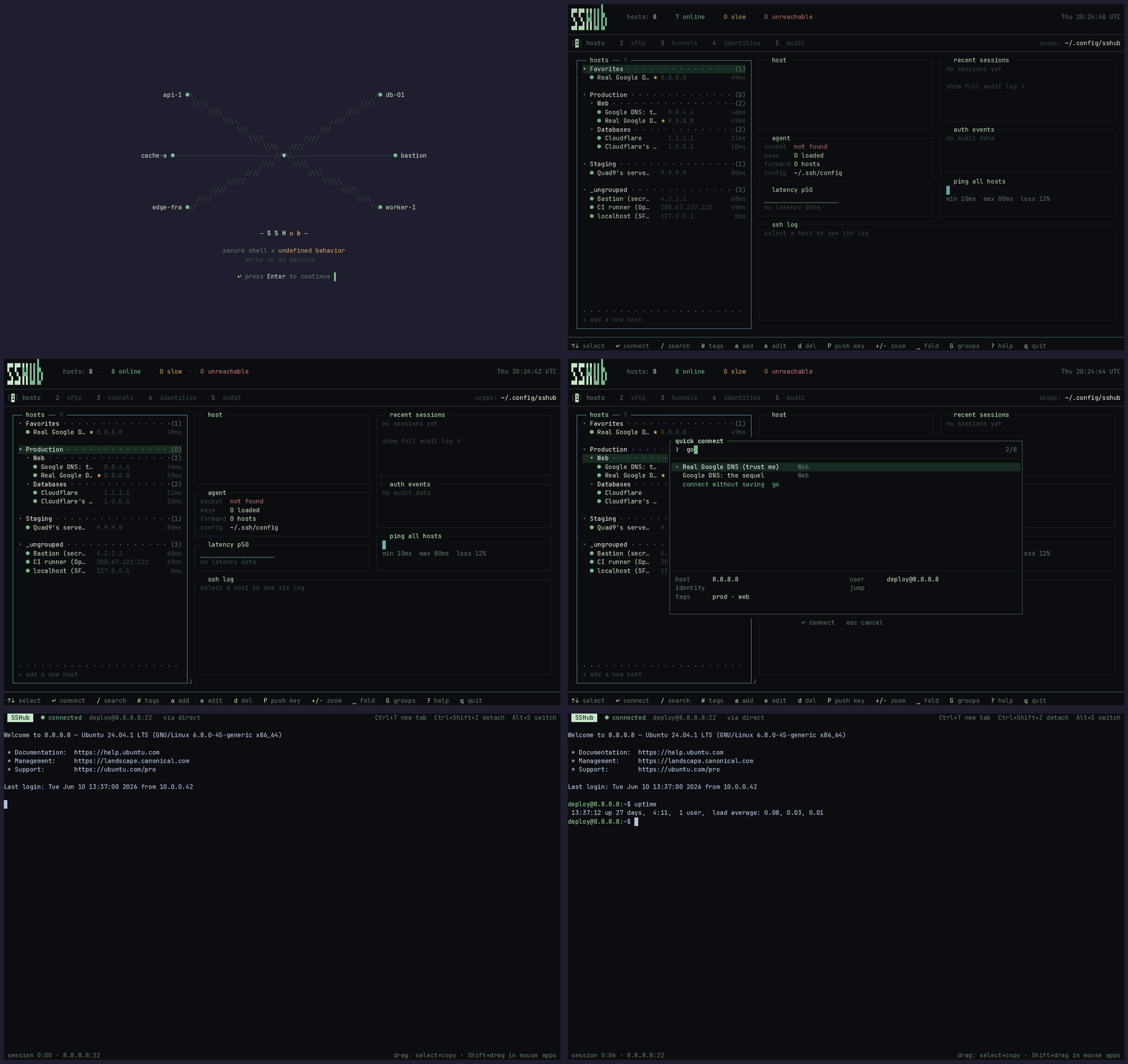
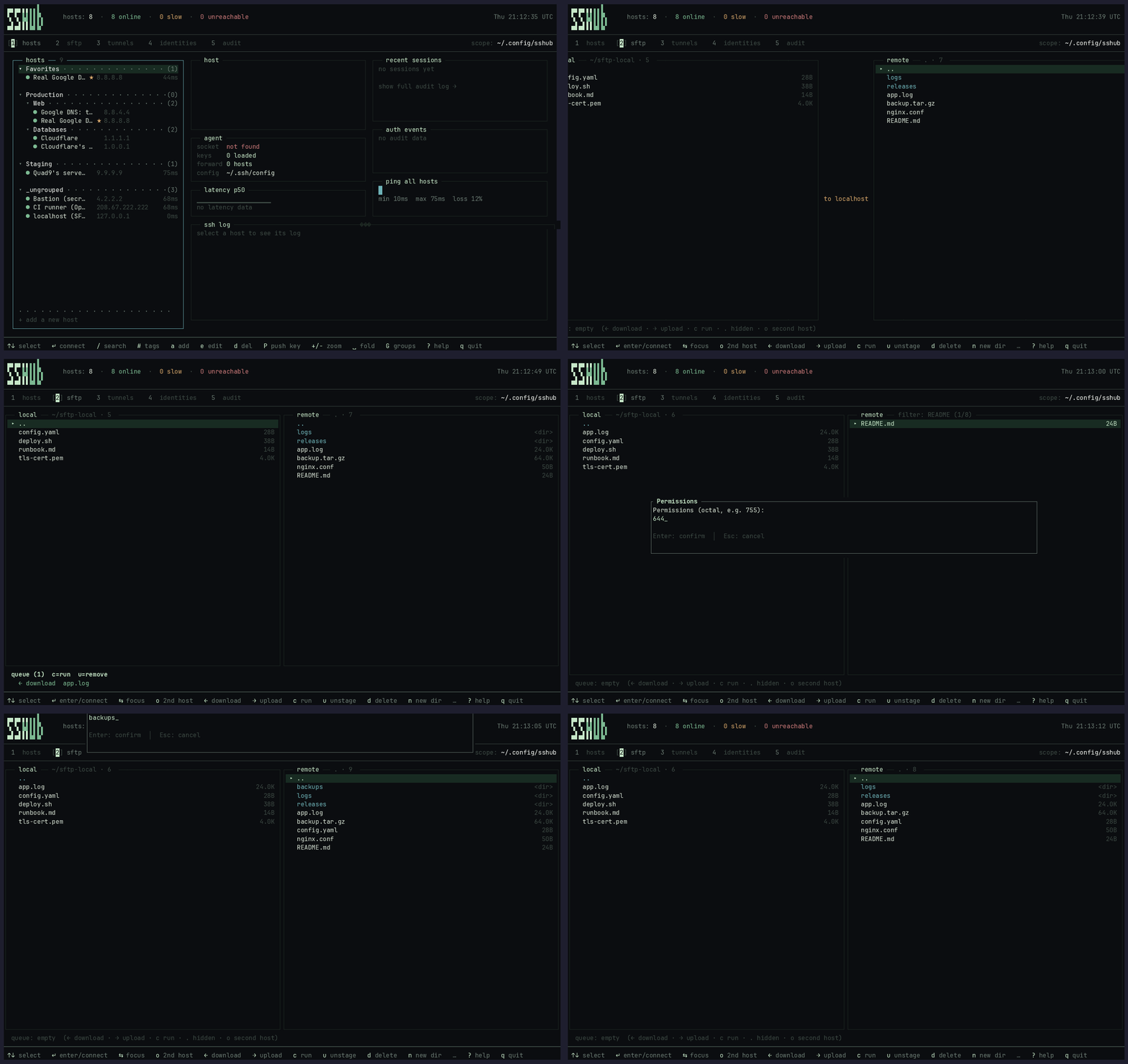
Navigating the dashboard — nested host groups, the fuzzy palette (`/`), the group manager (`Shift+G`), and the multi-tag filter (`#`):
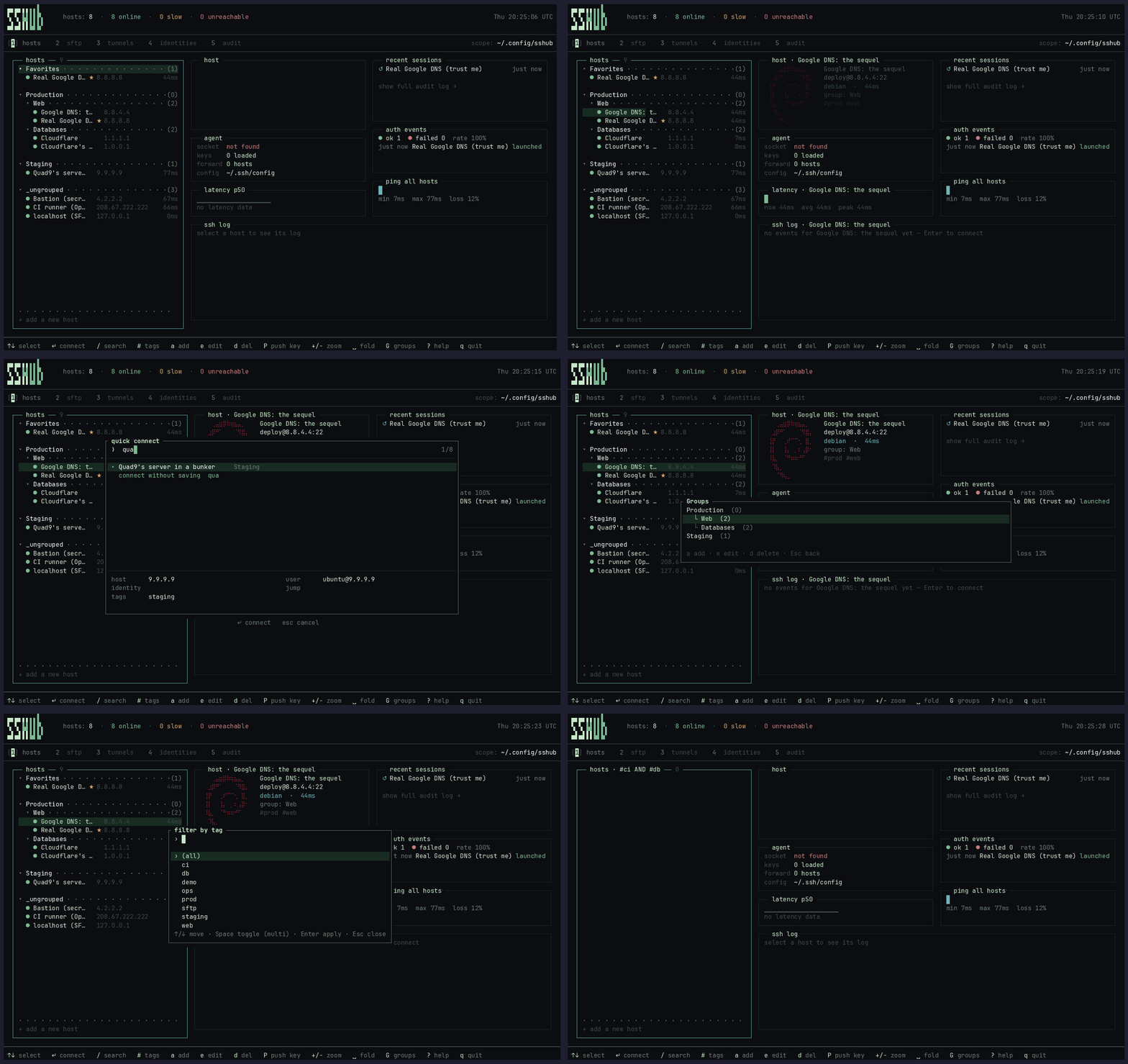
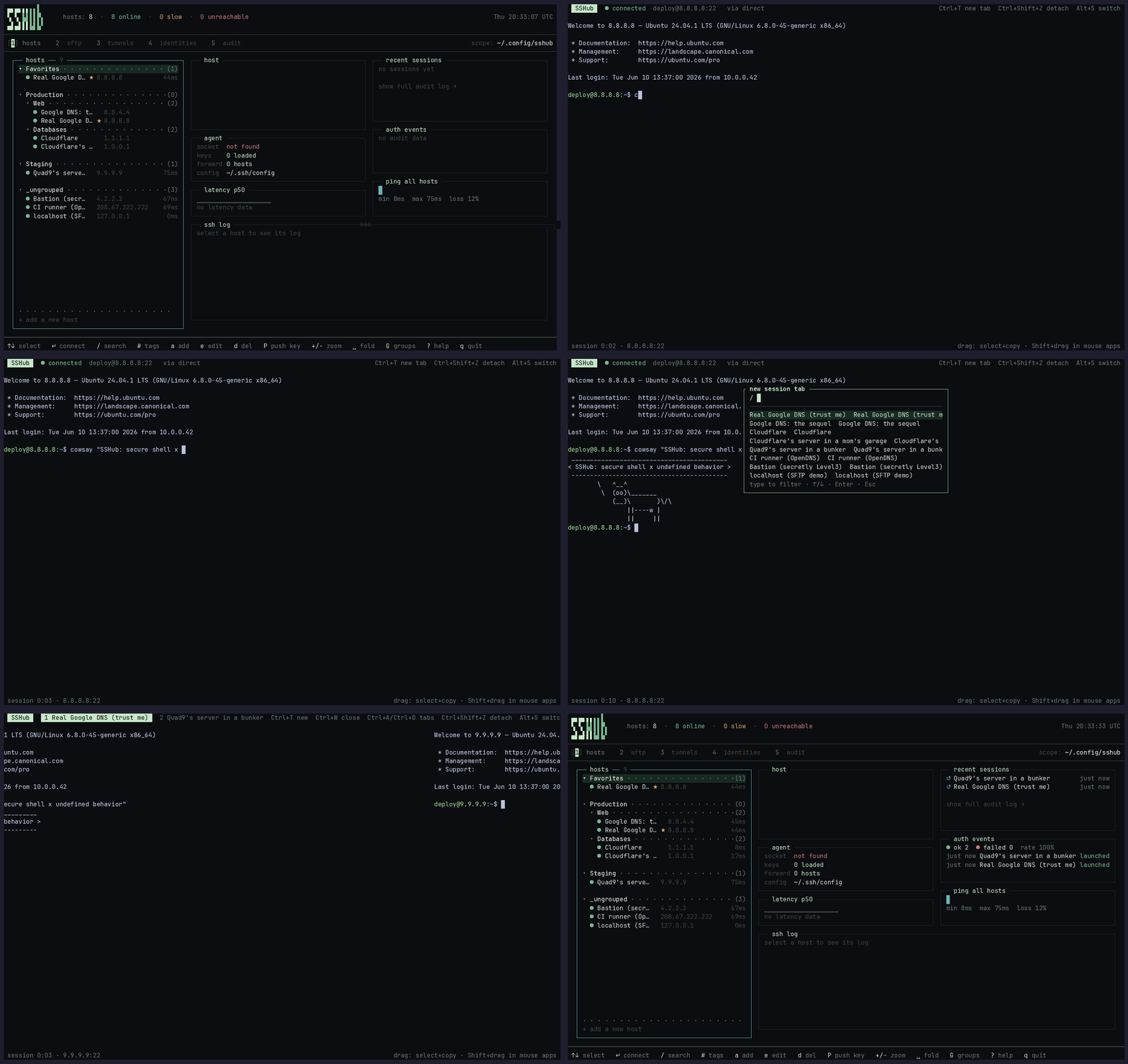
Connecting to a host — the session runs in an embedded PTY right inside the TUI:
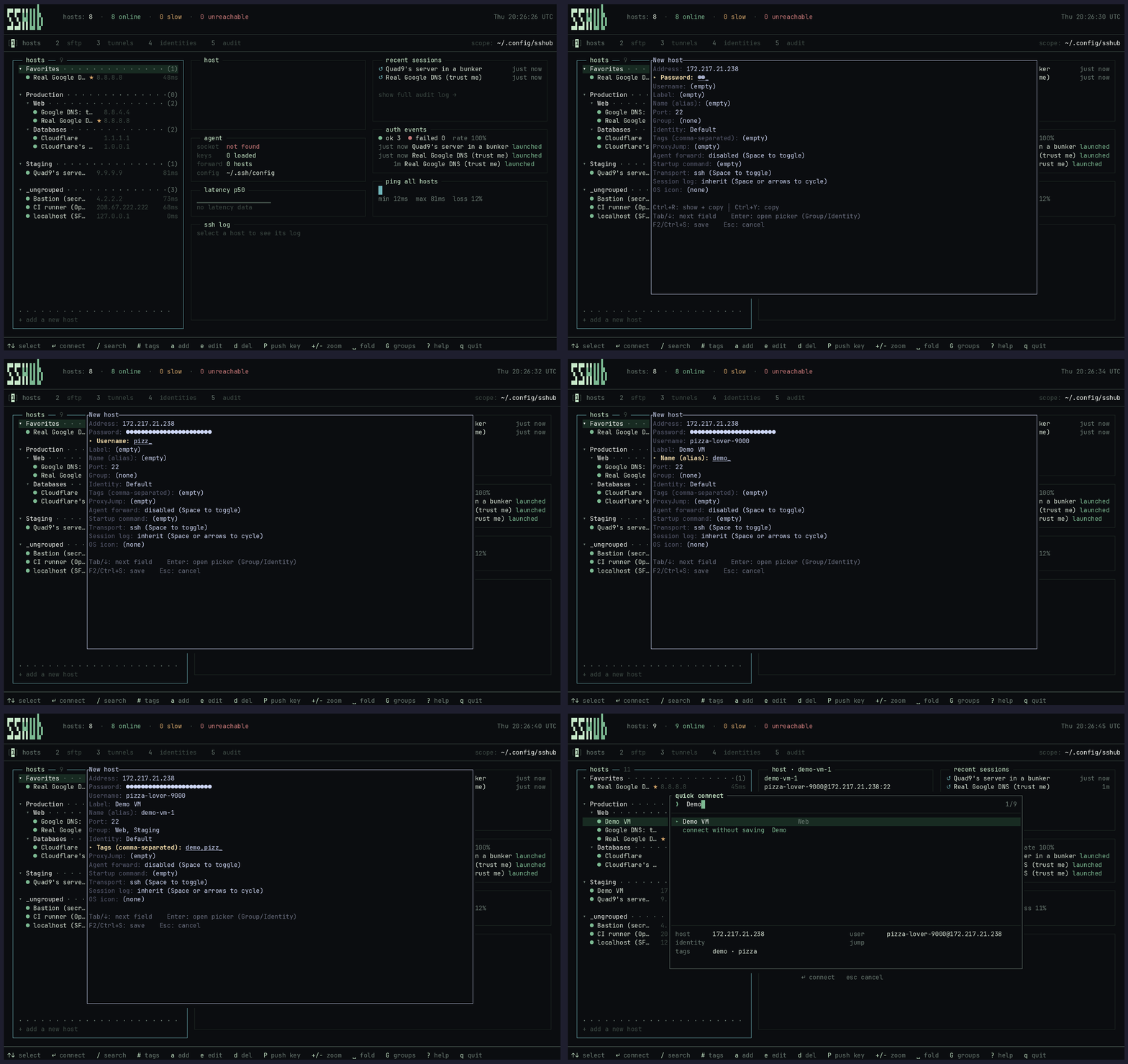
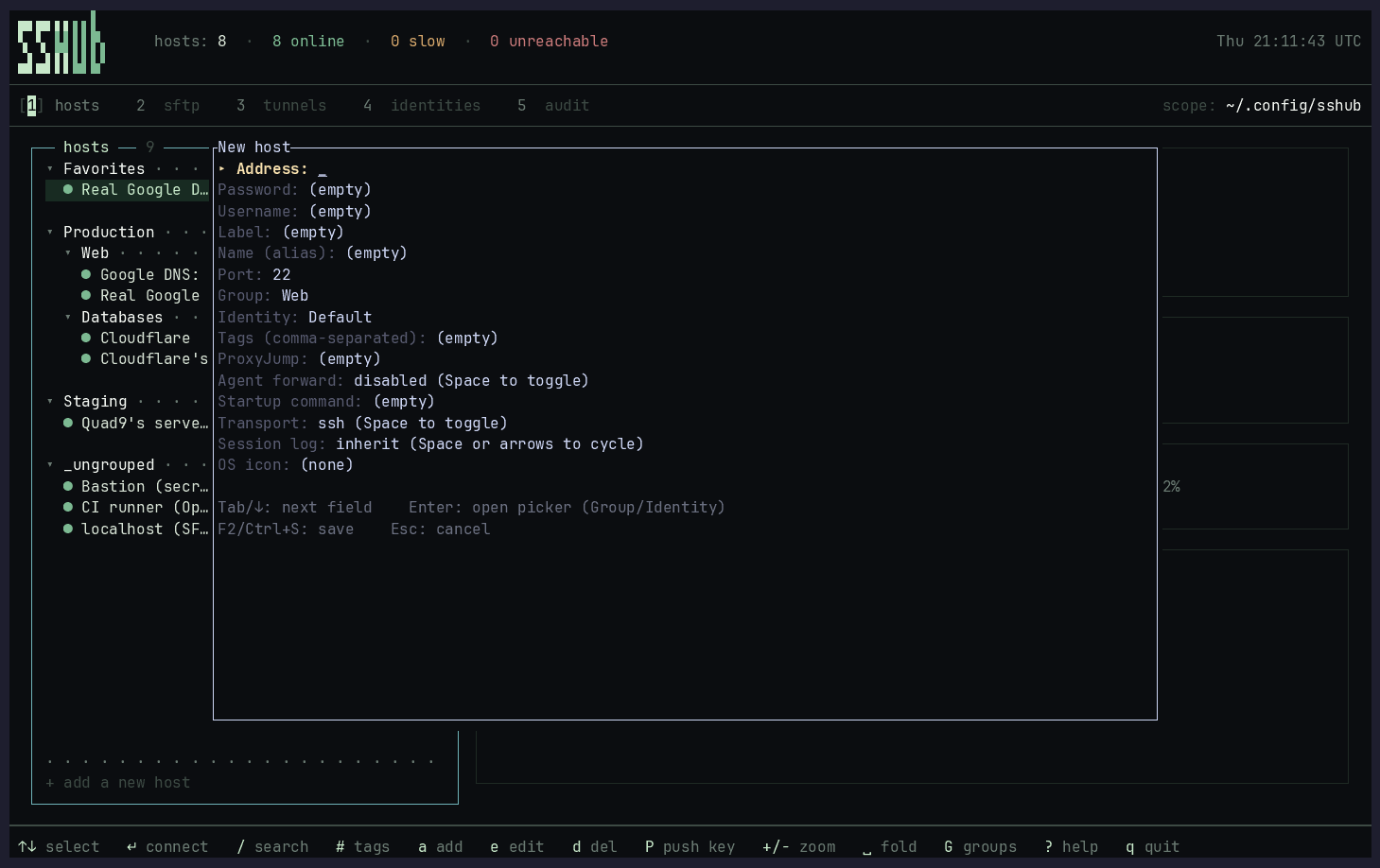
Adding a managed host and marking it as a favorite:
Transferring files over SFTP — a dual-pane browser (remote / local) with a staged transfer queue:
## Screenshots
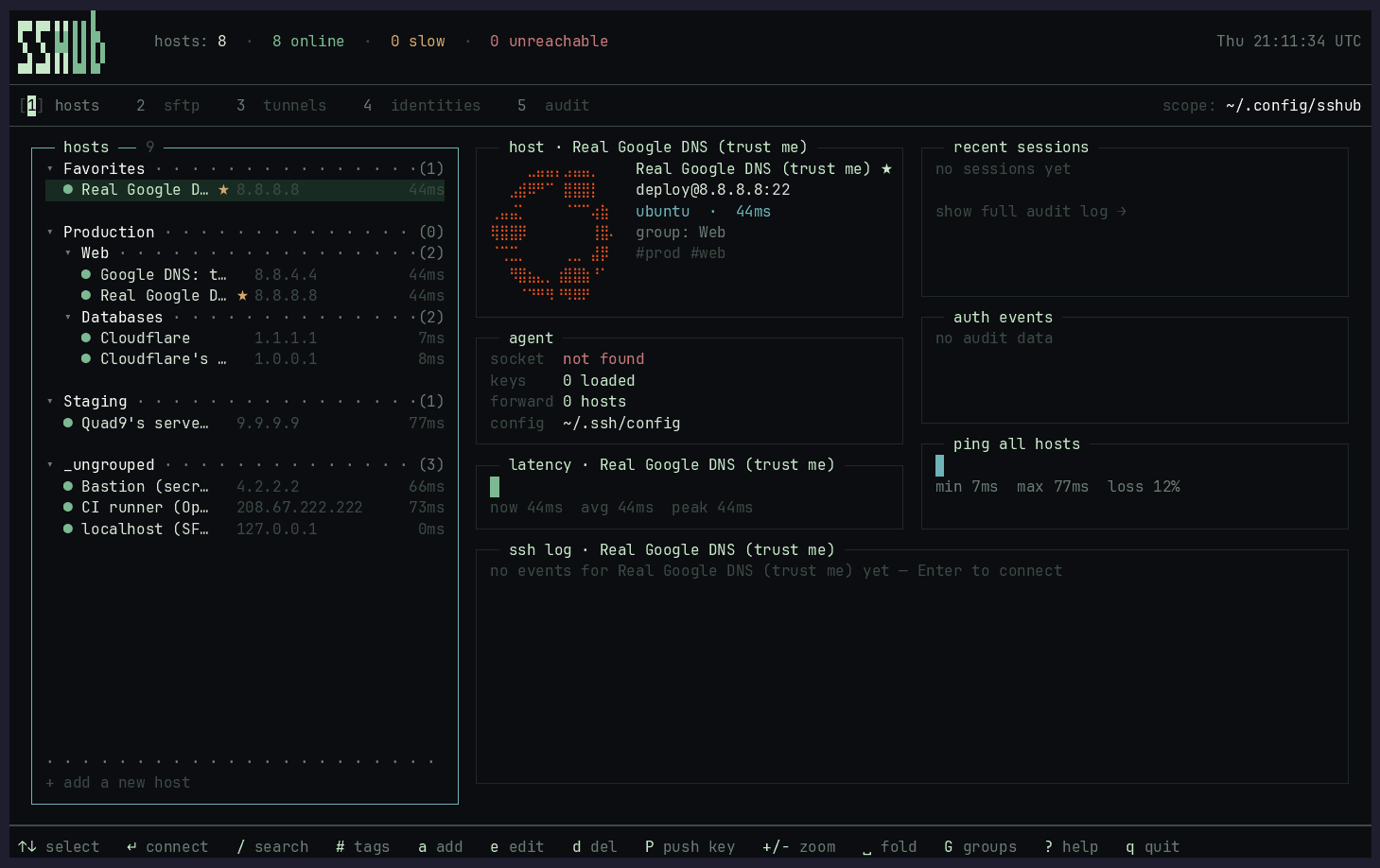
The hosts dashboard — nested groups on the left; the selected host's card shows its auto-detected OS logo, fact sheet, and per-host latency, with live agent / ping panels alongside:
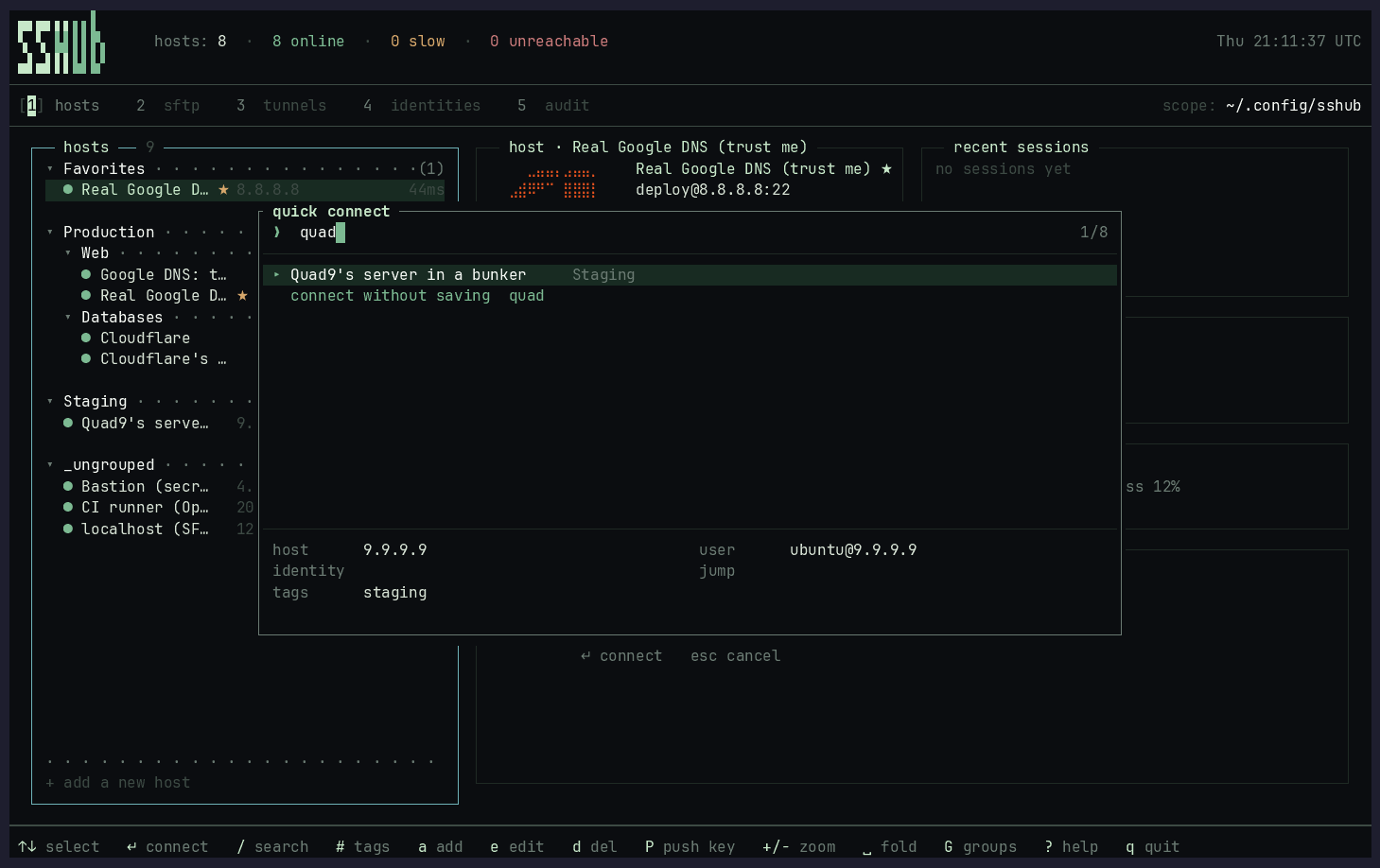
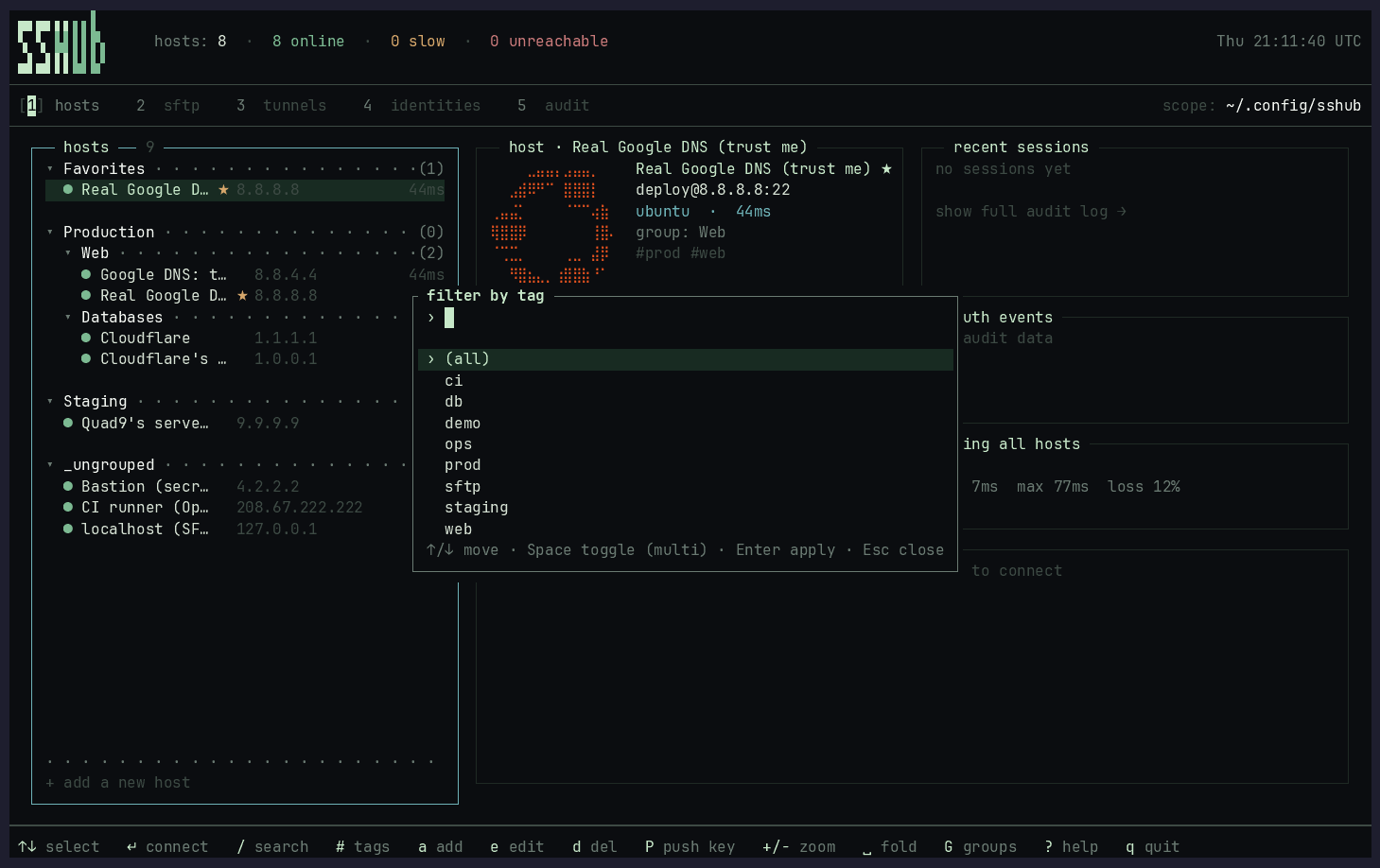
Fuzzy quick-connect palette (`/`) and the multi-tag filter (`#`):
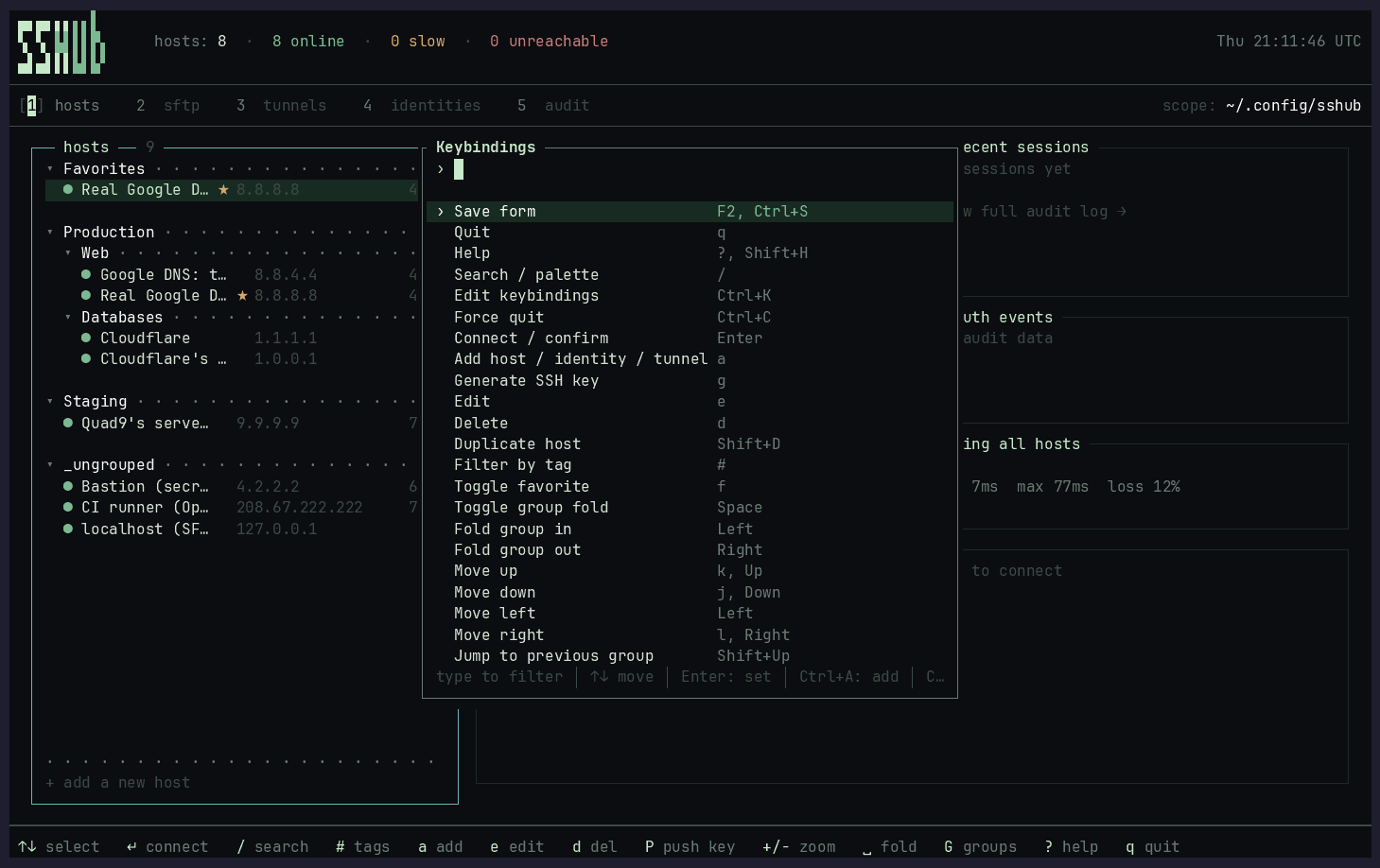
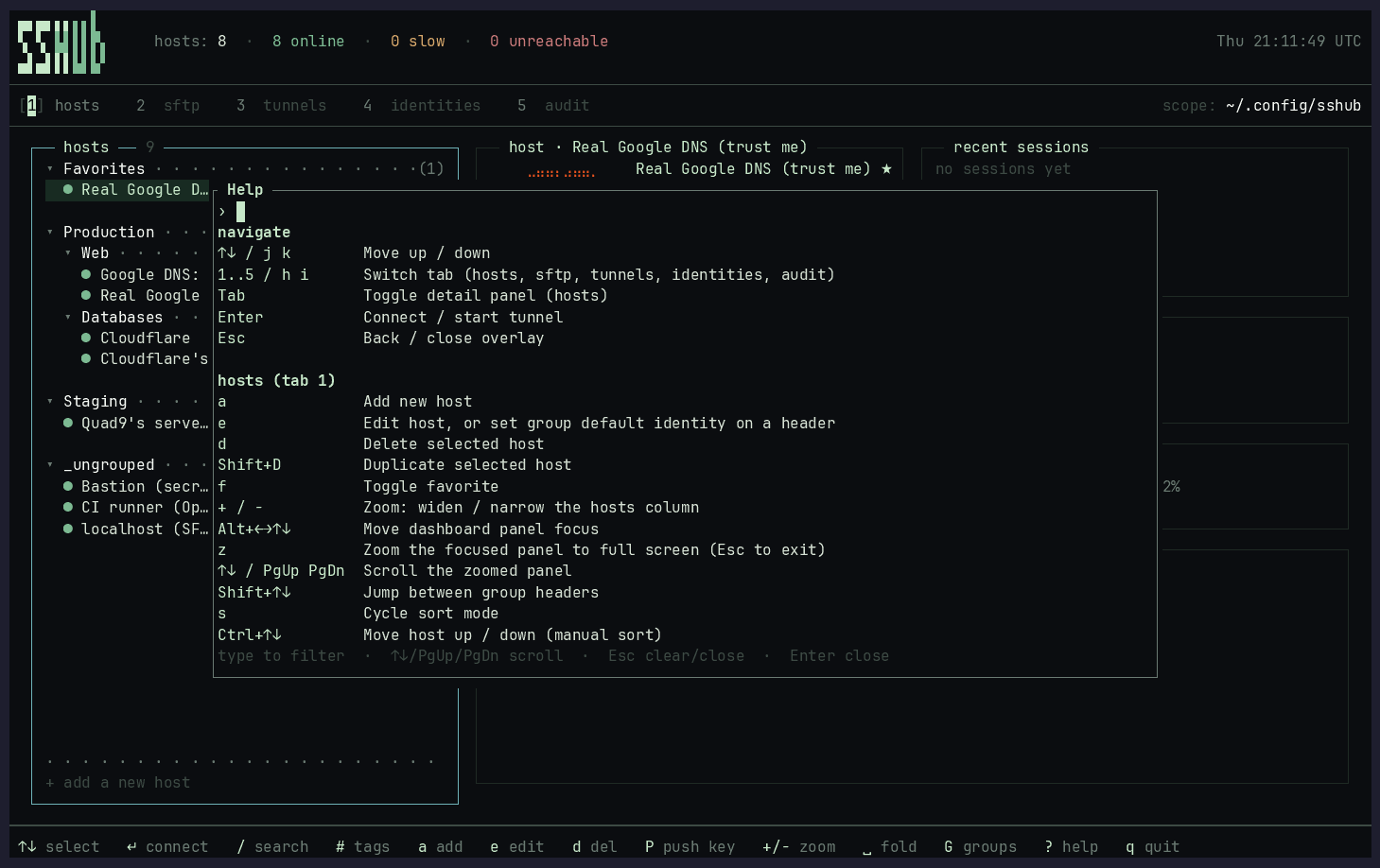
Add/edit host form, the rebindable keybindings editor (`Ctrl+K`), and the scrollable help overlay (`?`):
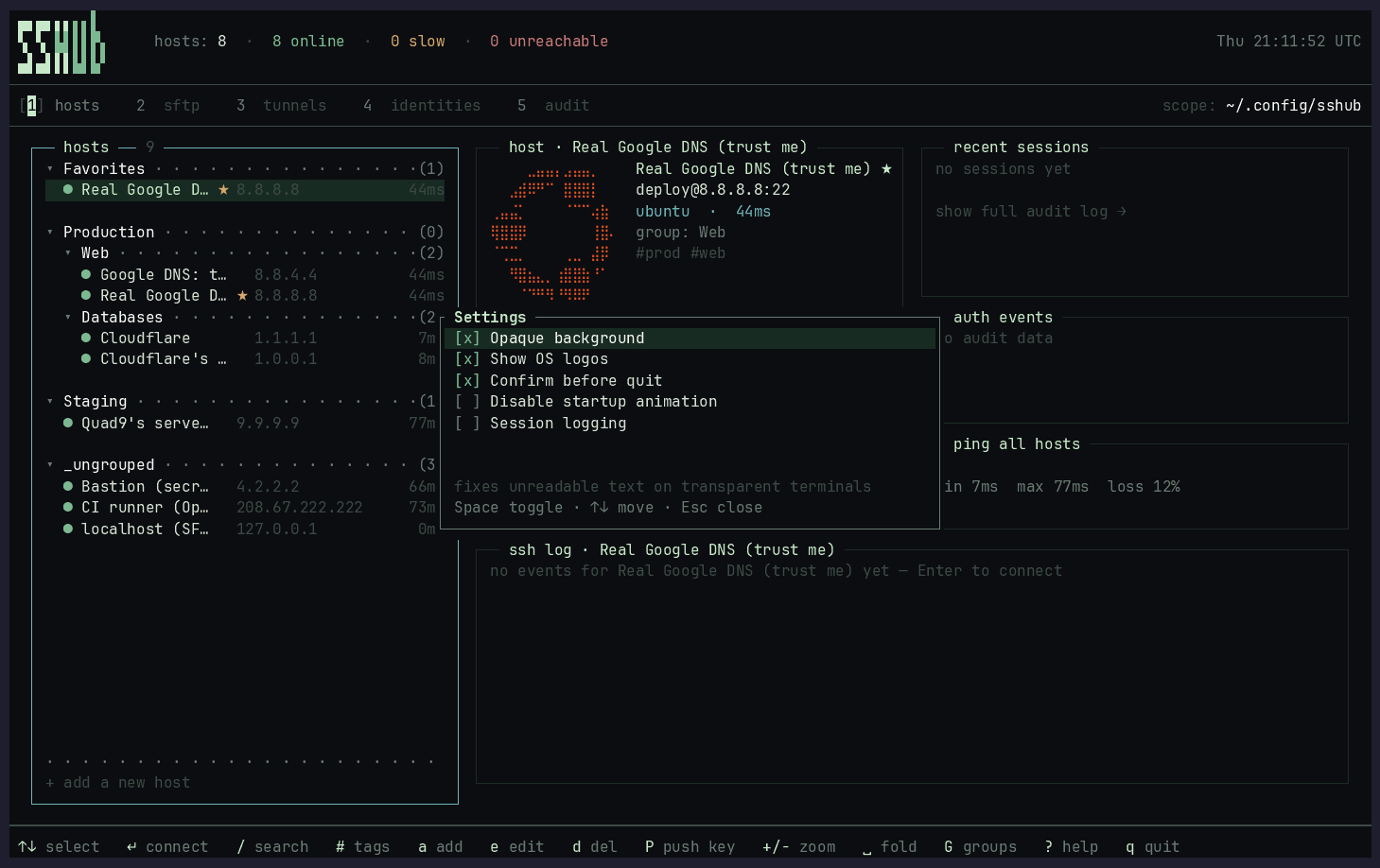
The settings overlay (`Ctrl+H`) — make SSHub's own surfaces or the remote grid transparent, toggle OS logos, quit confirmation, and the startup animation:
## Features
- **Embedded SSH sessions** — connect opens an in-TUI PTY; detach with Ctrl+D and return to the dashboard while SSH keeps running; multiple session tabs
- **Hosts** — browse, search, and connect. Fuzzy search with `/`, multi-tag AND filter with `#`, favorites, nested groups, manual sort order
- **SFTP file transfer** — a dual-pane browser with a staged transfer queue: navigate both sides, queue uploads and downloads (files or whole folders, transferred recursively), and run them with a progress bar. Files can be staged while the queue runs. The left pane is your local filesystem by default, or point it at a **second server** with `o` (`O` sends it back to local) to move files between two hosts — relayed through a local temp file, since SSH has no server-to-server copy. Manage files in place too: delete (`d`), new folder (`n`), rename/move (`R`), and change permissions (`M`, octal chmod)
- **OS auto-detection** — on first connect a background probe detects the remote distro and the host card renders its logo (Braille art in brand colors), just like Termius
- **Multiple groups & Favorites** — a host can belong to several groups at once; a reserved Favorites group and a ★ marker in the list, toggled with `f`
- **Tunnels** — define and manage SSH tunnels (local/remote/dynamic SOCKS). Start, stop, and monitor from the TUI. Per-tunnel **keep alive** auto-starts on launch and reconnects dropped forwards with exponential backoff (configurable in `config.toml`).
- **Keys** — identity management with ssh-agent integration. Add/remove keys from agent, see loaded status
- **Ad-hoc connect** - in the fuzzy palette (`/`), typing an unknown `[user@]host[:port]` (IPv6 in brackets supported) that matches no saved host offers a "connect without saving" row; Enter opens an embedded ssh session to it. Input is validated and injection-safe (no leading-dash hosts; destination passed after `--`)
- **Local shell tab** - `Ctrl+Shift+T` opens a session tab running your login shell (`$SHELL`, else `/bin/sh`) with the same detach/close semantics as ssh tabs
- **Command snippets** — a library of reusable commands (name, command, optional description and tags). Manage them from the dashboard with `Shift+S` (add/edit/delete); inside a live session `Ctrl+N` opens a fuzzy picker where `Enter` runs the selected command in the PTY and `Tab` inserts it without a trailing newline so you can edit before running
- **Audit** — log of all connection events with filtering by status (ok/fail) and time range (today/week/month); session connect events record the path to the session log when logging is enabled
- **Session logging** — opt-in capture of PTY session output to `~/.local/share/sshub/profiles/<name>/logs/<host-dir>/` (managed hosts use `{name}-{id}`; pure `~/.ssh/config` aliases without a launcher row may share a directory when sanitized names collide). Enable globally in Settings (`Ctrl+H`) or override per host (`inherit` / `on` / `off`). **Logs capture everything echoed to the terminal, including passwords if they appear on screen.**
- **Session log browser** (`Shift+L`): read those session logs inside the TUI. Pick a host, pick a rotated segment, and view it with terminal escape codes stripped so the transcript reads as plain text. In the viewer, `/` searches (case-insensitive), `n` / `N` step through matches, and `b` bookmarks the current line by name. `m` lists a host's bookmarks to jump straight back to a saved line. Reads are capped so a large transcript is never loaded whole.
- **Mosh transport** — per-host `Transport` field in the host form (`ssh` or `mosh`). Embedded sessions use `mosh` when selected; tunnels and SFTP stay ssh-only.
- **Settings overlay** (`Ctrl+H`) — toggle session logging, let your terminal show through SSHub's own surfaces or through the remote grid (two separate switches, both off by default), toggle OS logos, quit confirmation, and the startup animation
- **Headless CLI** — the whole inventory without the TUI: hosts, groups, identities, tunnels, one-shot SFTP, the audit log and themes, plus `sshub exec <host> -- <command>` to run a single command on a saved host and get its output and exit code back (with the stored identity, credential and ProxyJump applied). `--format json` on any listing, stable exit codes, completions for bash/zsh/fish — see [Headless CLI](#headless-cli)
- **Hybrid sources** — hosts from `~/.ssh/config` (read-only) and launcher-managed (full CRUD) merge without duplicates
- **Import/Export**: import from `~/.ssh/config`, Termius backups, PuTTY (a Windows regedit `.reg` export or a Unix `~/.putty/sessions` directory), or mRemoteNG (`confCons.xml`); export managed hosts back to ssh config format. Only SSH sessions are imported (RDP/VNC/telnet entries are skipped), and encrypted mRemoteNG passwords are not decrypted (imported hosts carry no stored secret)
- **Hot reload** — edits to `~/.ssh/config` update the host list live via file watcher
- **Configurable keybindings** — rebind any action via Ctrl+K; stored in `config.toml`
- **Mouse support** — click tabs, select rows, scroll panels, double-click to connect
## Install
From [npm](https://www.npmjs.com/package/sshub-tui), prebuilt, no toolchain required:
```bash
npx sshub-tui # run it without installing
npm install -g sshub-tui # then just: sshub
```
The installed command is `sshub`; the package is `sshub-tui` because npm rejects
the bare `sshub` name as too close to the existing `ssh2` and `sshpk`.
Prebuilt for Linux x64, macOS arm64 and macOS x64. The binary arrives as a
platform-specific optional dependency, so nothing is compiled and nothing is
fetched from outside the registry. Any other platform builds from source below.
From [crates.io](https://crates.io/crates/sshub):
```bash
cargo install sshub
```
Requires a Rust toolchain (edition 2021) and `ssh` in `PATH`.
On Linux, building also needs the D-Bus client library for the keyring
(Secret Service) backend that stores host passwords and key passphrases:
```bash
# Debian/Ubuntu
sudo apt-get install -y libdbus-1-dev pkg-config
# Fedora
sudo dnf install -y dbus-devel pkgconf-pkg-config
# Arch
sudo pacman -S --needed dbus
```
Prebuilt binaries for Linux and macOS are attached to each [GitHub release](https://github.com/Petyok/SSHub/releases).
At runtime, a Secret Service provider (gnome-keyring, KWallet, …) is preferred for secure credential storage. If one is not running or unlocked (e.g. in WSL, Docker, or headless SSH sessions), SSHub will fallback to storing credentials in a local owner-only restricted file (`credentials.json`), notifying you in the status bar.
```bash
git clone https://github.com/Petyok/SSHub.git
cd SSHub
just install # builds release binary + desktop entry + ~/.local/bin/sshub
```
Or build only:
```bash
just build
cp target/release/sshub ~/.local/bin/
```
## Usage
```bash
sshub # launch TUI
sshub --version # print version
sshub --dry-run # exit immediately (CI / scripts)
sshub --help # show options
sshub --profile work # launch named profile
sshub --manage-profiles # open profile picker
```
### Commands
```bash
# Wipe the launcher database — managed hosts, groups, identities, tunnels and
# the audit log. Irreversible, so it refuses unless you confirm. Your
# ~/.ssh/config (and the hosts imported from it) are left untouched.
sshub db purge --yes-i-am-stupid
# Target a profile from the TUI or any headless command.
sshub --profile work host list
sshub --profile personal audit list
sshub --profile work db purge --yes-i-am-stupid
```
SSHUB keeps profile-owned data isolated. Each profile can select its own SSH
config source with `[ssh].config_path`; the default remains shared
`~/.ssh/config`. With one profile, startup remains silent;
with multiple profiles, the picker appears after the splash. The picker can
create, rename, and delete profiles, but switching profiles requires restarting
SSHUB. `--profile NAME` bypasses the picker. `--manage-profiles` opens it even
when only one profile exists. Press `Esc` in the picker to cancel startup.
Headless commands without `--profile` use the last-used profile and never open
the interactive picker.
## Headless CLI
Beyond the TUI, `sshub` exposes a full command-line interface for scripting and
automation: hosts, groups, identities, tunnels, SFTP, and the audit log, no
terminal UI required. `sshub exec <host> -- <command>` runs a single command on
a saved host and hands back its output and exit code, so a script gets the
stored identity, credential and ProxyJump without rebuilding the ssh command
line by hand. Add `--format json` to any listing or show command for
machine-readable output (plain text is the default). Exit codes are stable:
`0` success, `1` operational failure, `2` usage or bad flags, and `124` when
`exec --timeout` kills the run (as `timeout(1)` does). Destructive commands
refuse to run without `--yes`.
```bash
# Hosts
sshub list # list hosts (alias for `host list`)
sshub connect prod-web # open an SSH session to a host
sshub host show prod-web --format json # host details as JSON
sshub host search web # fuzzy search
sshub host add --name prod-web --address 10.0.0.5 --port 22 \
--username deploy --group prod --tags web,prod
sshub host delete --name prod-web --yes # destructive: needs --yes
# Run a command on a host (scripted; exit code is the remote command's)
sshub exec prod-web -- systemctl is-active nginx
sshub exec prod-web -- 'tail -n 200 /var/log/nginx/error.log' > errors.log
echo "$payload" | sshub exec db-01 -- 'psql -f -'
sshub exec prod-web --timeout 30 --format json -- uptime
sshub exec prod-web -- 'ls && uptime' # quote it: bare `&&` runs locally
sshub exec prod-web --tty -- top # full-screen commands need a PTY
# Groups and identities
sshub groups # list host groups
sshub group add --name prod
sshub identity add --name work --username alice --private-key ~/.ssh/id_ed25519
sshub identity agent-remove --name work # ssh-add -d for the identity's key
# Tunnels
sshub tunnel list
sshub tunnel create --host prod-web --type local --local-port 8080 \
--remote-host localhost --remote-port 80
sshub tunnel start 3 # start detached (by id, label, or port)
sshub tunnel start 3 --foreground # run in the foreground with keep-alive
sshub tunnel stop 3
# SFTP (one-shot, over a direct host)
sshub sftp ls prod-web /var/log
sshub sftp get prod-web /var/log/app.log ./app.log
sshub sftp put prod-web ./deploy.tar.gz /tmp/deploy.tar.gz
sshub sftp rm prod-web /tmp/deploy.tar.gz --yes
# Themes (see "Theming" below)
sshub theme list
sshub theme show aqua
sshub theme check ~/.config/sshub/themes/mine.toml
# Audit log
sshub audit list --status fail --days 7
sshub audit stats --days 7
# Inventory sync with ~/.ssh/config
sshub import # import hosts from ssh config (--from ssh)
sshub import --from termius ./termius-export # import a Termius export dir (L00t.csv)
sshub import --from putty # import PuTTY sessions (~/.putty/sessions)
sshub import --from putty ./sessions.reg # or a Windows regedit .reg export
sshub import --from mremoteng ./confCons.xml # import an mRemoteNG confCons.xml
sshub import --from putty --dry-run # preview parsed hosts without writing
sshub sync # refresh ssh_config rows
sshub export --stdout # print an ssh_config snippet
# Shell completions
sshub completions zsh > ~/.zsh/completions/_sshub
sshub completions bash
sshub completions fish
```
Run `sshub <command> --help` for a per-command usage block, or `man sshub`
after `just install` (preview the page without installing with `just man`). See
[openwiki/workflows/cli.md](openwiki/workflows/cli.md) for the full command tree.
Shell completions are installed automatically by `just install` (bash and fish
drop into auto-loaded dirs; zsh gets a sourced line appended to `~/.zshrc`).
Run `just install-completions` to (re)install only the completions, or generate
one yourself with `sshub completions bash|zsh|fish`.
### Data paths
| Resource | Default path |
|------------|---------------------------------------|
| Config | `~/.local/share/sshub/profiles/<name>/config.toml` |
| Themes | `~/.local/share/sshub/profiles/<name>/themes/*.toml` |
| Databases | `~/.local/share/sshub/profiles/<name>/{launcher,metadata}.db` |
| Logs | `~/.local/share/sshub/profiles/<name>/logs/` |
| Tunnels | `~/.local/share/sshub/profiles/<name>/tunnels/` |
| State | `~/.local/share/sshub/state.toml` |
| SSH config | `~/.ssh/config` |
Override via environment variables: `SSHUB_CONFIG_DIR`, `SSHUB_DATA_DIR`,
`SSHUB_SSH_CONFIG`. Setting `SSHUB_CONFIG_DIR` or `SSHUB_DATA_DIR` selects
compatibility mode, using those directories verbatim and disabling profile
discovery. Legacy `SSH_LAUNCHER_*` variables remain supported.
## Keybindings
Defaults below. Rebind any action with **Ctrl+K** (saved to `config.toml`). Press `?` in-app for the full list.
### Global
| Key | Action |
|------------------|---------------------------------|
| `1`..`5` | Switch tab (hosts/sftp/tunnels/identities/audit) |
| `Tab` | Toggle detail panel |
| `Esc` | Back / close overlay |
| `Ctrl+K` | Keybind editor |
| `?` | Help screen |
| `q` | Quit |
### Session (embedded PTY)
| Key | Action |
|------------------------|-------------------------------------|
| `Ctrl+T` | New session tab (host picker) |
| `Ctrl+Shift+T` | Local shell tab |
| `Ctrl+W` | Close session tab |
| `Ctrl+D` | Detach to dashboard (SSH keeps running) |
| `Ctrl+[` / `Ctrl+]` | Previous / next session tab |
| `Ctrl+Shift+S` | Focus session from dashboard |
| `Alt+S` | Switch to an open session (searchable) |
| `PgUp`/`PgDn`, wheel | Scroll session history; both go to the remote app while it holds the alternate screen (tmux, vim, less), where the wheel becomes arrow keys |
| drag | Select terminal text, copied on release; `Shift` inverts it when the remote app owns the mouse |
`Ctrl+W` closes a session tab, but inside a form it kills the word before the
cursor (`Ctrl+U` kills everything before it) — the host, identity and tunnel
forms take readline's editing chords.
The wheel inside `tmux` reaches tmux's own scrollback only with
`set -g mouse on`; without it tmux never asks for the mouse, so the notch
arrives as arrow keys, exactly as in a real terminal.
### Hosts (tab 1)
| Key | Action |
|--------------------|---------------------------|
| `j`/`k` or arrows | Navigate |
| `Enter` | Connect to host |
| `a` | Add host |
| `e` | Edit host / group identity |
| `d` | Delete host |
| `D` | Duplicate host |
| `f` | Toggle favorite |
| `s` | Cycle sort mode |
| `Alt`+arrows | Move dashboard panel focus |
| `z` | Zoom focused panel (Esc to exit) |
| `/` | Fuzzy search |
| `/` + `[user@]host` | Ad-hoc connect (unknown host, no save) |
| `#` | Filter by tags (AND) |
| `Shift+G` | Manage groups (nested) |
| `Shift+I` | Import from ssh config |
| `Shift+E` | Export to ssh config |
| `Shift+T` | Import from Termius |
| `Shift+P` | Push public key to host |
### SFTP (tab 2)
| Key | Action |
|--------------------|-----------------------------------------------------|
| `Enter` | Connect to host · enter directory (`..` walks up) |
| `Tab` | Switch focus between the panes |
| `Backspace` | Up one directory |
| `←` / `→` | Stage the focused pane's selection toward the other |
| `c` / `u` | Run the queue / unstage the last transfer |
| `o` / `O` | Left pane to a second server / back to local files |
| `.` | Show / hide dotfiles in both panes (remembered) |
| `d` | Delete (recursive) |
| `n` / `R` / `M` | New folder / rename / chmod |
| `r` | Refresh both panes |
| `s` | Open an SSH session to this host |
| `/` | Filter the focused pane |
| `Esc` | Disconnect, back to the picker |
### Tunnels (tab 3)
| Key | Action |
|-----------|----------------------------------|
| `a` | Add tunnel |
| `e` | Edit tunnel |
| `d` | Delete tunnel |
| `Enter` | Start / stop / cancel reconnect |
| `R` | Reconnect settings |
| `x` | Kill tunnel process |
### Keys (tab 3)
| Key | Action |
|------------|--------------------------|
| `a` | Add identity |
| `e` | Edit identity |
| `d` | Delete identity |
| `g` | Generate SSH key pair |
| `r` | Remove key from agent |
| `Shift+A` | Add key to agent |
| `Shift+P` | Push public key to host |
| `H` | Known hosts manager |
### Audit (tab 4)
| Key | Action |
|-----|--------------------------------------|
| `f` | Cycle filter (all / ok / fail) |
| `r` | Cycle range (all / today / week / month) |
## Theming
SSHub's colours live in TOML theme files you can copy, edit and switch at
runtime. Five themes ship built into the binary — **`default`**, **`summer`**,
**`aqua`**, **`fire`** and **`high-contrast`** — and your own go in the
selected profile's `themes/*.toml` directory (or `~/.config/sshub/themes/` in
compatibility mode), where the file name is the theme's ID.
```bash
mkdir -p ~/.local/share/sshub/profiles/<name>/themes
sshub theme show aqua > ~/.local/share/sshub/profiles/<name>/themes/mine.toml
$EDITOR ~/.local/share/sshub/profiles/<name>/themes/mine.toml
sshub theme check ~/.local/share/sshub/profiles/<name>/themes/mine.toml
```
Select it in the TUI with **Ctrl+H → Theme… → Enter**: moving through the list
previews each theme on the whole interface, `Esc` rolls back, and `Enter` saves
`appearance.active_theme` to `config.toml`. Nothing else is written.
A theme sets any of three layers — your own `[palette]`, the fixed 25-slot
`[semantic]` core, and per-role `[components]` overrides — plus named static
`[gradients]`. Everything you leave out is inherited from `default`, so
changing one semantic slot recolours everything that uses it. True Color
terminals get the colours as written. The embedded remote session keeps every
colour the remote chose itself; a theme only supplies the ground and the default
foreground the remote left unset.
Three headless commands, all without a TUI or a database:
| Command | What it does |
|---------|--------------|
| `sshub theme list` | Every built-in and user theme with its state |
| `sshub theme show <id> [--resolved]` | The theme's source, or a fully resolved standalone export |
| `sshub theme check <file>` | Strict validation with `file:line:column` diagnostics |
**Full guide: [docs/theme-system.md](docs/theme-system.md)** — the file format,
colour values and simulated opacity, inheritance and `"auto"`, gradient
directions and the `perimeter` rule, the complete role catalogue, every picker
key, the CLI exit codes, and two copy-pasteable example themes.
## Configuration
`~/.local/share/sshub/profiles/<name>/config.toml` in profile mode
(`~/.config/sshub/config.toml` in compatibility mode):
```toml
[session_logging]
enabled = false
max_file_bytes = 10485760 # rotate at 10 MiB
retention_files = 50 # keep newest 50 logs per host
[tunnel_reconnect]
max_attempts = 12 # 0 = unlimited retries
initial_delay_ms = 1000 # 1 s (R overlay edits delays in seconds)
max_delay_ms = 60000 # 60 s
stable_secs = 5 # uptime before a spawn counts as up
jitter_ratio = 0.25
[clipboard]
relay_from_pty = true # let apps inside a session copy to your clipboard
```
## Development
```bash
just build # release binary
just test # all tests (unit + smoke + e2e + config)
cargo run -- --dry-run # quick sanity check
```
### Test levels
| Level | Command | What it checks |
|----------|-------------------------------|--------------------------------------|
| Unit | `cargo test` | Logic, parsers, fixtures -- no TTY |
| Smoke | `cargo test --test smoke` | Binary starts, `--help`, `--dry-run` |
| E2E | `cargo test --test e2e` | TUI scenarios via TestBackend |
| Config | `cargo test --test config_load` | Config file creation and loading |
### Environment variables
| Variable | Purpose |
|--------------------|--------------------------------------------|
| `SSHUB_CONFIG_DIR` | Override config directory |
| `SSHUB_DATA_DIR` | Override data/SQLite directory |
| `SSHUB_SSH_CONFIG` | Override SSH config file path |
| `SSHUB_DRY_RUN` | Exit immediately without TUI |
| `SSHUB_AUTO_QUIT` | `1` = quit after first draw, `q` = send quit key |
## Tech stack
[Rust](https://www.rust-lang.org/) with [ratatui](https://ratatui.rs/) + [crossterm](https://github.com/crossterm-rs/crossterm) for the TUI, [rusqlite](https://github.com/rusqlite/rusqlite) (bundled SQLite) for storage, [nucleo](https://github.com/helix-editor/nucleo) for fuzzy search, [notify](https://github.com/notify-rs/notify) for file watching. No async runtime -- synchronous event loop with 50ms polling.
## Model credits
Made with dynamic workflows + adversarial-multimodel-reviews + cross-model-reviews. Models with commits, reviews, or blocked merges to their name, in order of appearance:
- Opus 4.8
- Opus 5
- Fable 5
- Composer 2.5
- Grok 4.5
- Qwen 3.8 Max
- GPT-5.6 Luna
## License
[AGPL-3.0-or-later](LICENSE) — a copyleft license: forks and derivatives must
stay open under the same terms. (Versions ≤ 0.3.1 were released under MIT.)
## Changelog
See [CHANGELOG.md](CHANGELOG.md).