io.github.tiago-marques/x-openapi-flow-mcp
OpenAPI lifecycle guard and MCP sidecar for policy-driven API orchestration.
Open source Open in the app JSON README (API)
About
OpenAPI lifecycle guard and MCP sidecar for policy-driven API orchestration.
Details
- Kind
- MCP servers
- Topic
- Developer tools
- Publisher
- tiago-marques
- Origin
- official
- Category
- ferramentas
- Transport
- local
- Version
- 1.7.4
- Stars
- 5
- Last push
- 2026-05-02T21:09:53Z
- Repository state
- ativo
- Language
- JavaScript
- License
- MIT
- Added
- 2026-08-29 04:01:33
- Updated
- 2026-08-29 04:01:33
- Origin id
io.github.tiago-marques/x-openapi-flow-mcp
README
# OpenAPI describes APIs. x-openapi-flow turns them into executable workflows — for developers and AI agents.
## Define your API workflows in openapi.x.json and execute them without writing custom clients or orchestration logic

[](https://www.npmjs.com/package/x-openapi-flow)
[](https://www.npmjs.com/package/x-openapi-flow)


[](https://github.com/tiago-marques/x-openapi-flow/actions/workflows/x-openapi-flow-validate.yml)
[](https://github.com/tiago-marques/x-openapi-flow/issues)
[](https://github.com/tiago-marques/x-openapi-flow/commits/main)

> 🚀 2,100+ downloads in the first 3 weeks!
## ⚡ Get started in seconds
```
npx x-openapi-flow init --suggest-transitions
```
### This generates an openapi.x.json file where you can declaratively define how your API should be executed — not just described.
> See your API lifecycle come alive from your OpenAPI spec, with one simple command
> Validate, document, and generate flow-aware SDKs automatically.
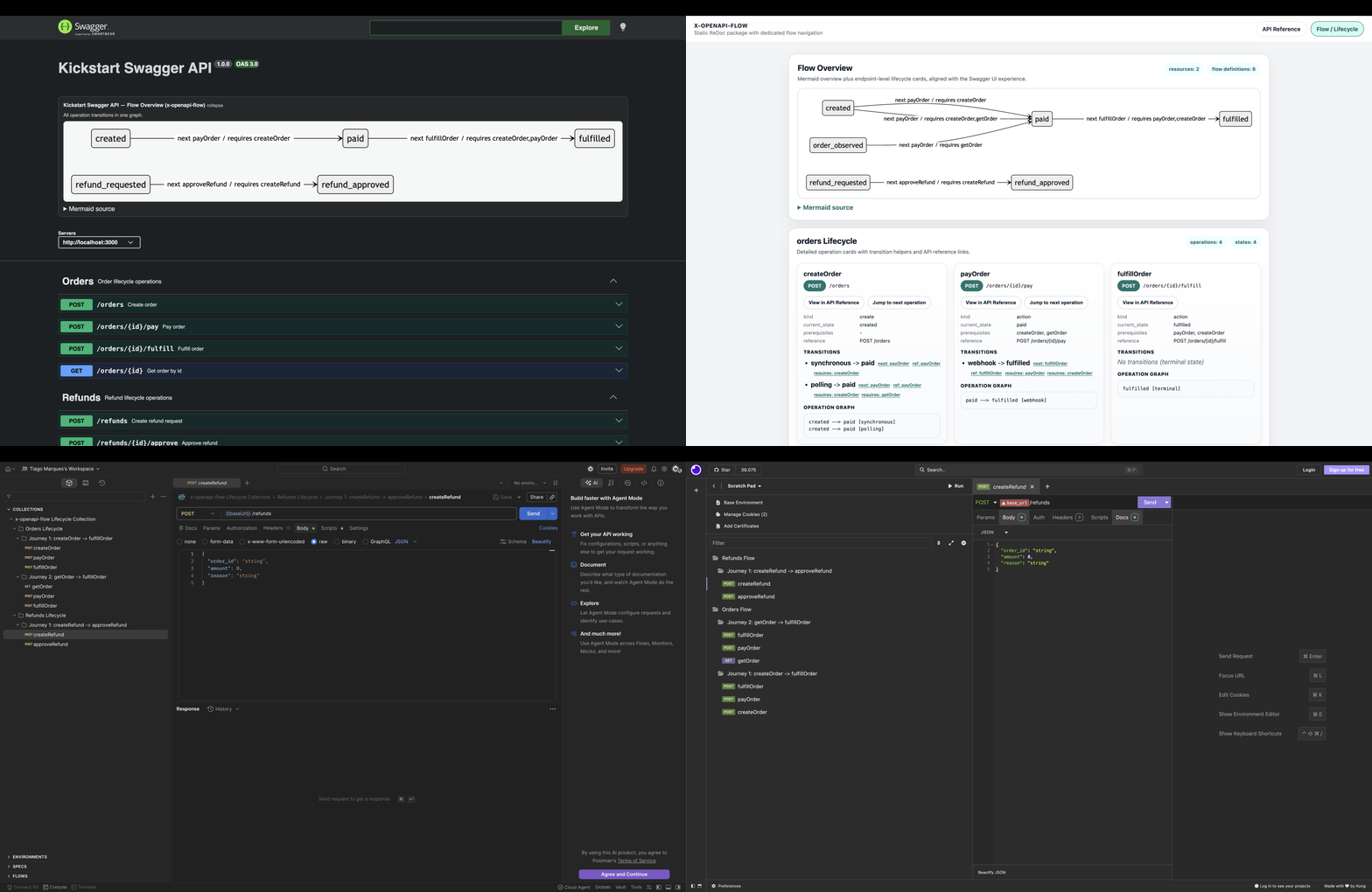
## What is this?
### x-openapi-flow extends your OpenAPI specification with a workflow layer.
> openapi.json → describes your API
> openapi.x.json → describes how to use it (flows)
### Instead of writing imperative code to orchestrate API calls, you define workflows declaratively and run them anywhere.
`x-openapi-flow` adds a **declarative state machine** to your OpenAPI spec.
Model resource lifecycles, enforce valid transitions, and generate flow-aware artifacts for documentation, SDKs, and automation.
## 🚀 Example
> Define stateful workflows and lifecycle transitions directly inside your OpenAPI operations:
```json
{
"operationId": "createOrder",
"x-openapi-flow": {
"version": "1.0",
"id": "create-order",
"current_state": "created",
"description": "Creates an order and starts the lifecycle",
"transitions": [
{
"transition_id": "order-created-to-paid",
"trigger_type": "synchronous",
"condition": "Payment is confirmed",
"decision_rule": "payOrder:response.200.body.payment_status == 'approved'",
"target_state": "paid",
"next_operation_id": "payOrder",
"operation_role": "mutate",
"prerequisite_operation_ids": ["createOrder"],
"evidence_refs": [
"payOrder:response.200.body.payment_status"
],
"propagated_field_refs": [
"createOrder:response.201.body.order_id"
],
"failure_paths": [
{
"reason": "Payment denied",
"target_state": "payment_failed",
"next_operation_id": "getOrder"
}
]
}
]
}
}
```
This flow defines an order lifecycle directly inside your OpenAPI:
* Starts in the `created` state
* Transitions to `paid` when payment is confirmed
* Supports both synchronous and polling-based transitions
* Propagates data between operations automatically
* Can include explicit decision/evidence and failure-path metadata for AI-guided orchestration
Instead of manually orchestrating API calls, the workflow is fully described alongside your API specification.
## Why This Exists
Building APIs is cheap. Building **complex, multi-step APIs that teams actually use correctly** is hard.
Teams face recurring problems:
- 📄 **Manual documentation is brittle** – OpenAPI specs are static, often out of sync with real workflows
- 🤖 **AI agents can hallucinate** – LLMs and code-generating agents may produce invalid calls if workflows are unclear or undocumented
- 🤯 **Workflows are confusing** – multi-step operations are hard to track for humans and AI agents
- ⚠️ **Invalid calls slip through** – developers make mistakes because lifecycle rules aren’t enforced
- ⏱️ **Integration slows down** – SDKs, Postman collections, and docs need constant manual updates
- 🛡️ **Hard to prevent errors in production** – without explicit lifecycle rules, invalid operations can reach live systems, causing outages or inconsistencies
x-openapi-flow exists to **solve these pains**: it makes lifecycles explicit, validates transitions automatically, and generates flow-aware docs and SDKs — **so teams move faster, make fewer mistakes, and ship confident integrations**.
## What This Enables
Turn your OpenAPI spec into a single source of truth for API behavior:
- Visualize API lifecycles directly in [Swagger UI](#swagger-ui-demo) and [Redoc](#redoc-demo)
- Validate flows and state transitions in [CI pipelines](#cli-commands)
- Generate [lifecycle diagrams automatically](#mermaid-example) from your OpenAPI spec
- Build [SDKs](#sdk-generation) that understand and respect API workflows
- Export [Postman](#postman-demo) and [Insomnia](#insomnia-demo) collections organized by lifecycle
- Create [AI-ready API contracts](https://github.com/tiago-marques/x-openapi-flow/blob/main/docs/wiki/engineering/AI-Sidecar-Authoring.md) for agentic integrations
## Quick Start (without OpenAPI file)
## Start in 2 Minutes (Online Playground)
Prefer no local setup? Open the minimal runtime-guard demo directly in your browser:
- StackBlitz: https://stackblitz.com/github/tiago-marques/x-openapi-flow/tree/main/example/runtime-guard/minimal-order
- Codespaces (repo): https://github.com/tiago-marques/x-openapi-flow
Once open, run:
```bash
npm install
npm run start
```
Then in another terminal:
```bash
curl -s -X POST http://localhost:3110/orders
curl -i -X POST http://localhost:3110/orders/<id>/ship
```
Expected: `409 INVALID_STATE_TRANSITION`.
Fastest way to see value (guided scaffold):
```bash
npx x-openapi-flow quickstart
cd x-openapi-flow-quickstart
npm install
npm start
```
Optional runtime:
```bash
npx x-openapi-flow quickstart --runtime fastify
```
Then run:
```bash
curl -s -X POST http://localhost:3110/orders
curl -i -X POST http://localhost:3110/orders/<id>/ship
```
Expected: `409 INVALID_STATE_TRANSITION`.
---
### If you already have an OpenAPI file, use the sidecar workflow:
Initialize flow support in your project:
```bash
npx x-openapi-flow init
# optional: infer suggested transitions using naming heuristics
npx x-openapi-flow init --suggest-transitions
```
After regenerating your OpenAPI file, apply and validate the flow (optional):
```bash
npx x-openapi-flow apply openapi.yaml --out openapi.flow.yaml
npx x-openapi-flow validate openapi.flow.yaml --profile strict --strict-quality
```
This will:
- enrich your OpenAPI spec with flow metadata
- validate lifecycle consistency
- catch invalid transitions early
💡 Tip: run this in CI to enforce API workflow correctness
### Less Verbose DSL for Large Flows
For larger APIs, you can define flow rules by resource (with shared transitions/defaults) and reduce duplication in sidecar files.
See: [Sidecar Contract](https://github.com/tiago-marques/x-openapi-flow/blob/main/docs/wiki/reference/Sidecar-Contract.md)
### GitHub Action (One-Step CI Validation)
Use the official reusable action to validate lifecycle rules in CI with a single step:
```yaml
- name: Validate OpenAPI flow rules
uses: tiago-marques/x-openapi-flow@v1
with:
openapi-file: openapi.flow.yaml
profile: strict
strict-quality: "true"
```
Integration guide: [GitHub-Actions-Integration.md](https://github.com/tiago-marques/x-openapi-flow/blob/main/docs/wiki/integrations/GitHub-Actions-Integration.md)
<a id="mermaid-example"></a>
### Real Lifecycle Example
Here’s a real-world payment lifecycle represented in x-openapi-flow:
```
CREATED -> AUTHORIZED -> CAPTURED -> REFUNDED
```
Generate a visual graph of the lifecycle:
```bash
npx x-openapi-flow graph openapi.flow.yaml --format mermaid
```
Resulting diagram:
```mermaid
graph TD
CREATED --> AUTHORIZED
AUTHORIZED --> CAPTURED
CAPTURED --> REFUNDED
```
> This visualization makes your API workflow explicit, easy to communicate, and ready for documentation or demos.
<a id="sdk-generation"></a>
## Generate Flow-Aware SDKs
Create a TypeScript SDK that **respects your API’s lifecycle and transition rules**, following best practices seen in leading companies like **Stripe** and **Adyen**:
- **Orchestrator by model**: each resource exposes methods that enforce valid transitions
- **Chainable API calls**: perform sequences naturally and safely
```bash
npx x-openapi-flow generate-sdk openapi.flow.yaml --lang typescript --output ./sdk
```
Example usage:
```ts
const payment = await sdk.payments.create({ amount: 1000 });
await payment.authorize();
await payment.capture();
```
> This SDK guides developers through valid transition paths, following patterns used by market leaders to ensure safe and intuitive integrations.
## Runtime Enforcement (Express + Fastify)
CI validation is important, but production safety needs request-time enforcement.
`x-openapi-flow` now includes an official runtime guard for Node.js that can block invalid state transitions during request handling.
- Works with **Express** and **Fastify**
- Resolves operations by `operationId` (when available) or by method + route
- Reads current resource state using your own persistence callback
- Blocks invalid transitions with explicit `409` error payloads
Install and use directly in your API server:
```js
const {
createExpressFlowGuard,
createFastifyFlowGuard,
} = require("x-openapi-flow/lib/runtime-guard");
```
Express example:
```js
const express = require("express");
const { createExpressFlowGuard } = require("x-openapi-flow/lib/runtime-guard");
const openapi = require("./openapi.flow.json");
const app = express();
app.use(
createExpressFlowGuard({
openapi,
async getCurrentState({ resourceId }) {
if (!resourceId) return null;
return paymentStore.getState(resourceId); // your DB/service lookup
},
resolveResourceId: ({ params }) => params.id || null,
})
);
```
Fastify example:
```js
const fastify = require("fastify")();
const { createFastifyFlowGuard } = require("x-openapi-flow/lib/runtime-guard");
const openapi = require("./openapi.flow.json");
fastify.addHook(
"preHandler",
createFastifyFlowGuard({
openapi,
async getCurrentState({ resourceId }) {
if (!resourceId) return null;
return paymentStore.getState(resourceId);
},
resolveResourceId: ({ params }) => params.id || null,
})
);
```
Error payload for blocked transition:
```json
{
"error": {
"code": "INVALID_STATE_TRANSITION",
"message": "Blocked invalid transition for operation 'capturePayment'. Current state 'CREATED' cannot transition to this operation.",
"operation_id": "capturePayment",
"current_state": "CREATED",
"allowed_from_states": ["AUTHORIZED"],
"resource_id": "pay_123"
}
}
```
More details: [Runtime Guard](https://github.com/tiago-marques/x-openapi-flow/blob/main/docs/wiki/reference/Runtime-Guard.md)
### Built-in Persistence Adapters
No need to write your own `getCurrentState` from scratch. x-openapi-flow ships four ready-made adapters:
```js
const {
MemoryAdapter, // in-process Map — ideal for tests and single-instance dev
FileAdapter, // JSON file on disk — great for demos and local servers
RedisAdapter, // ioredis-backed — production-ready, requires: npm install ioredis
GenericSQLAdapter, // any SQL DB (pg, mysql2, knex…) via query callback
} = require("x-openapi-flow/lib/runtime-guard");
// in-memory (testing / local)
const store = new MemoryAdapter();
app.use(createExpressFlowGuard({ openapi, ...store.forGuard() }));
// persist every transition to Redis
const Redis = require("ioredis");
const redisStore = new RedisAdapter({ client: new Redis(), prefix: "orders:" });
app.use(createExpressFlowGuard({ openapi, ...redisStore.forGuard() }));
// call setState after each successful request to keep the state in sync
app.post("/orders/:id/pay", async (req, res) => {
await redisStore.setState({ resourceId: req.params.id, state: "paid" });
res.json({ ok: true });
});
```
**GenericSQLAdapter** example with `pg`:
```js
const { Pool } = require("pg");
const pool = new Pool();
const sqlStore = new GenericSQLAdapter({
query: (sql, params) => pool.query(sql, params).then(r => r.rows),
dialect: "pg",
});
await sqlStore.ensureTable(); // CREATE TABLE IF NOT EXISTS xflow_state (…)
app.use(createExpressFlowGuard({ openapi, ...sqlStore.forGuard() }));
```
All adapters implement `getCurrentState`, `setState`, `deleteState` and `forGuard()` — a convenience method that returns the exact shape expected by the guard options.
### Observability Hooks (Metrics/Audit)
You can instrument runtime decisions with `onDecision` to feed Prometheus, logs, or tracing.
```js
const { Counter } = require("prom-client");
const { createExpressFlowGuard } = require("x-openapi-flow/lib/runtime-guard");
const flowDecisions = new Counter({
name: "xflow_runtime_guard_decisions_total",
help: "Runtime guard decisions by type and operation",
labelNames: ["decision", "operation_id"],
});
app.use(
createExpressFlowGuard({
openapi,
...store.forGuard(),
onDecision(event) {
flowDecisions.inc({
decision: event.decision,
operation_id: event.operationId || "unknown",
});
},
})
);
```
Common decision values include:
- `allowed_transition`
- `allowed_idempotent_state`
- `allowed_initial_state`
- `denied_invalid_transition`
- `denied_missing_resource_id`
- `denied_unknown_operation`
- `skipped_unknown_operation`
Want to see the value immediately? Use the official minimal demo:
- [example/runtime-guard/minimal-order/README.md](https://github.com/tiago-marques/x-openapi-flow/blob/main/example/runtime-guard/minimal-order/README.md)
Run in under 5 minutes:
```bash
cd example/runtime-guard/minimal-order
npm install
npm start
```
Create an order, then try to ship before payment (must return `409 INVALID_STATE_TRANSITION`):
```bash
curl -s -X POST http://localhost:3110/orders
curl -i -X POST http://localhost:3110/orders/<id>/ship
```
HTTPie equivalent:
```bash
http POST :3110/orders
http -v POST :3110/orders/<id>/ship
```
## Programmatic State Machine Engine
Use a reusable deterministic engine independently of CLI and OpenAPI parsing:
```js
const { createStateMachineEngine } = require("x-openapi-flow/lib/state-machine-engine");
const engine = createStateMachineEngine({
transitions: [
{ from: "CREATED", action: "confirm", to: "CONFIRMED" },
{ from: "CONFIRMED", action: "ship", to: "SHIPPED" },
],
});
engine.canTransition("CREATED", "confirm");
engine.getNextState("CREATED", "confirm");
engine.validateFlow({ startState: "CREATED", actions: ["confirm", "ship"] });
```
More details: [State Machine Engine](https://github.com/tiago-marques/x-openapi-flow/blob/main/docs/wiki/reference/State-Machine-Engine.md)
### OpenAPI to Engine Adapter
Convert `x-openapi-flow` metadata to a pure engine definition:
```js
const { createStateMachineAdapterModel } = require("x-openapi-flow/lib/openapi-state-machine-adapter");
const { createStateMachineEngine } = require("x-openapi-flow/lib/state-machine-engine");
const model = createStateMachineAdapterModel({ openapiPath: "./openapi.flow.yaml" });
const engine = createStateMachineEngine(model.definition);
```
More details: [OpenAPI State Machine Adapter](https://github.com/tiago-marques/x-openapi-flow/blob/main/docs/wiki/reference/OpenAPI-State-Machine-Adapter.md)
## Who Benefits Most
x-openapi-flow is ideal for teams and organizations that want **clear, enforceable API workflows**:
- **API-first organizations** – maintain a single source of truth for API behavior
- **Teams building AI agents** – provide AI-friendly contracts and enforce correct API usage, so agents can safely call endpoints in the right order without guessing or violating workflow rules
- **API platform teams** – ensure consistent lifecycle rules across endpoints
- **Companies with complex API workflows** – reduce errors and ambiguity in multi-step processes
- **SDK teams** – generate flow-aware SDKs that guide developers
## Why x-openapi-flow?
See how **x-openapi-flow extends OpenAPI** to make your API workflows explicit, enforceable, and actionable:
| Capability | OpenAPI | x-openapi-flow |
| --- | --- | --- |
| Endpoint contracts | ✅ Yes | ✅ Yes (fully compatible, extended) |
| Lifecycle states | ❌ No | ✅ Yes – define states for each resource |
| Transition validation | ❌ No | ✅ Yes – catch invalid calls before runtime |
| Flow diagrams | ❌ No | ✅ Yes – generate visual lifecycle graphs |
| Usage guidance (next valid actions) | Limited/manual | ✅ Built-in via lifecycle metadata – guides developers and AI agents |
### How does it compare to OpenAPI Workflows (Arazzo) and AsyncAPI?
| Dimension | x-openapi-flow | OpenAPI Workflows (Arazzo) | AsyncAPI |
| --- | --- | --- | --- |
| **Primary focus** | Resource lifecycle states & runtime enforcement | Multi-step API workflows (orchestration scripts) | Event-driven / async messaging APIs |
| **Lifecycle states** | ✅ Explicit states per resource | ❌ No state model | ❌ No state model |
| **Runtime enforcement** | ✅ Express/Fastify middleware (409 on invalid transitions) | ❌ Spec-only, no runtime guard | ❌ Spec-only |
| **SDK generation** | ✅ TypeScript, Kotlin, Python, Go | ❌ No codegen | Limited |
| **Postman / Insomnia export** | ✅ Built-in adapters | ❌ No | ❌ No |
| **AI agent support** | ✅ MCP sidecar + structured sidecar contract | ❌ No | ❌ No |
| **Breaking change detection** | ✅ `diff --breaking-only --fail-on-breaking` | ❌ No | ❌ No |
| **CI validation** | ✅ CLI + GitHub Action | ❌ No official CLI | Limited |
| **OpenAPI compatibility** | ✅ Sidecar extends existing specs | Separate Arazzo spec | Separate AsyncAPI spec |
**In short:** use x-openapi-flow when you need **enforceable, stateful API lifecycles** that go beyond documentation into runtime safety, SDK generation, and AI-ready contracts. Use Arazzo for scripting multi-step HTTP journeys. Use AsyncAPI for documenting event/message-driven systems.
## Integration Demos
Explore how x-openapi-flow integrates with popular API tools, making lifecycles and flows explicit for documentation and testing.
<a id="swagger-ui-demo"></a>
### Swagger UI – Visualize Flows in Your Docs
```bash
cd example/swagger-ui
npm install
npm run apply
npm start
```
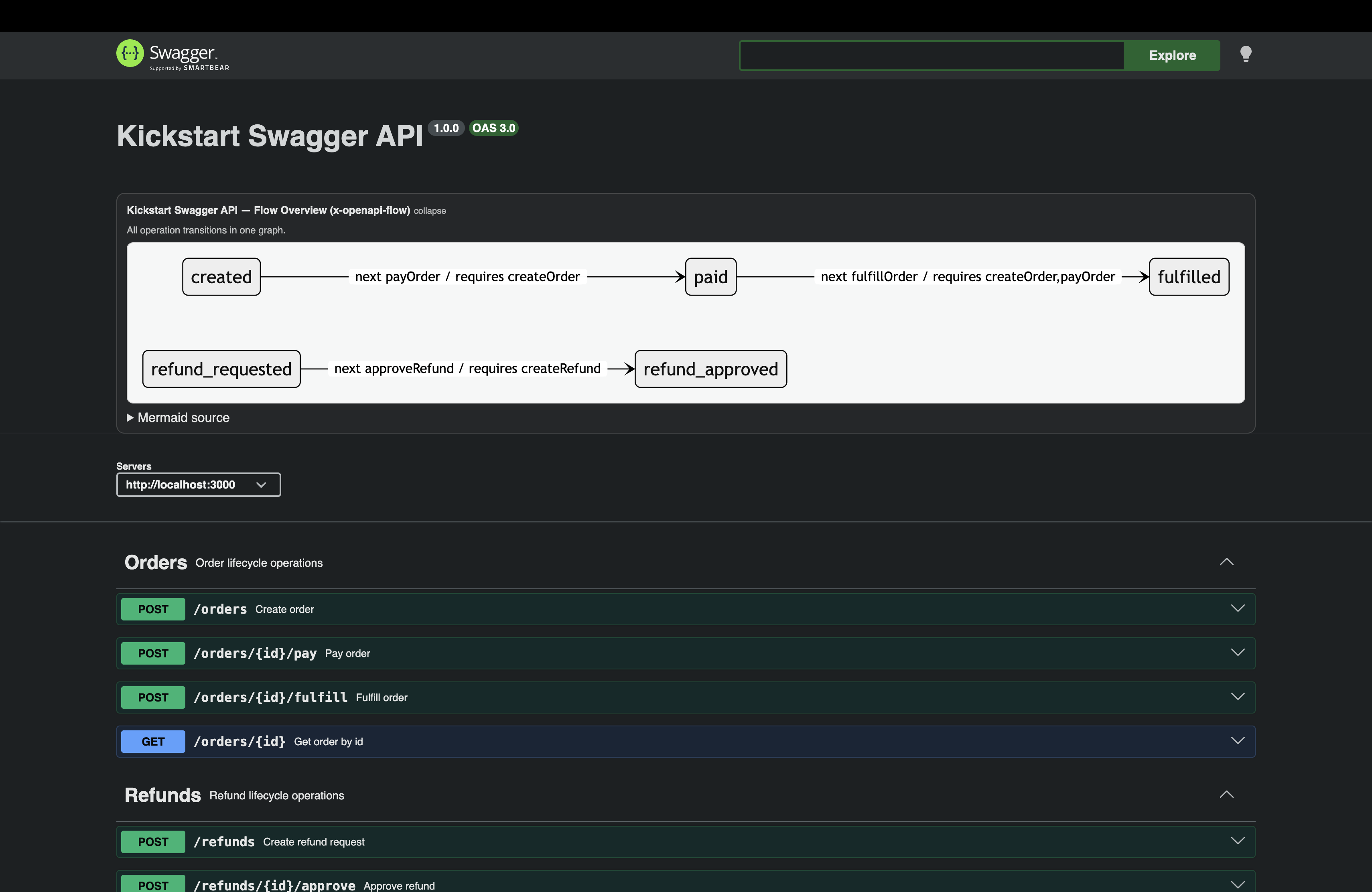
> Lifecycle panel shows valid states and transitions
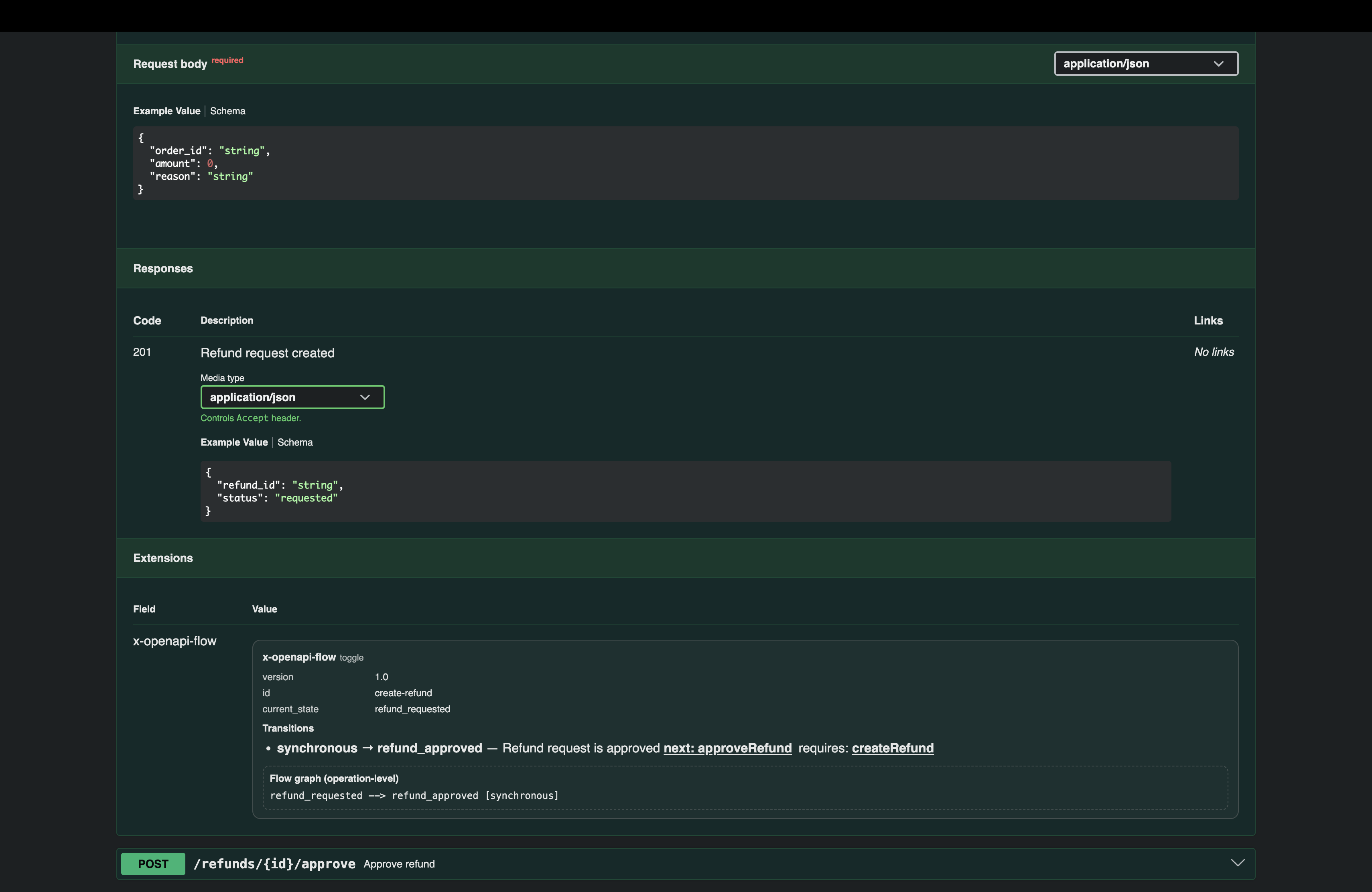
> Detailed view of transitions per operation
<a id="redoc-demo"></a>
### Redoc – Flow-Aware Documentation
```bash
cd example/redoc
npm install
npm run apply
npm run generate
```
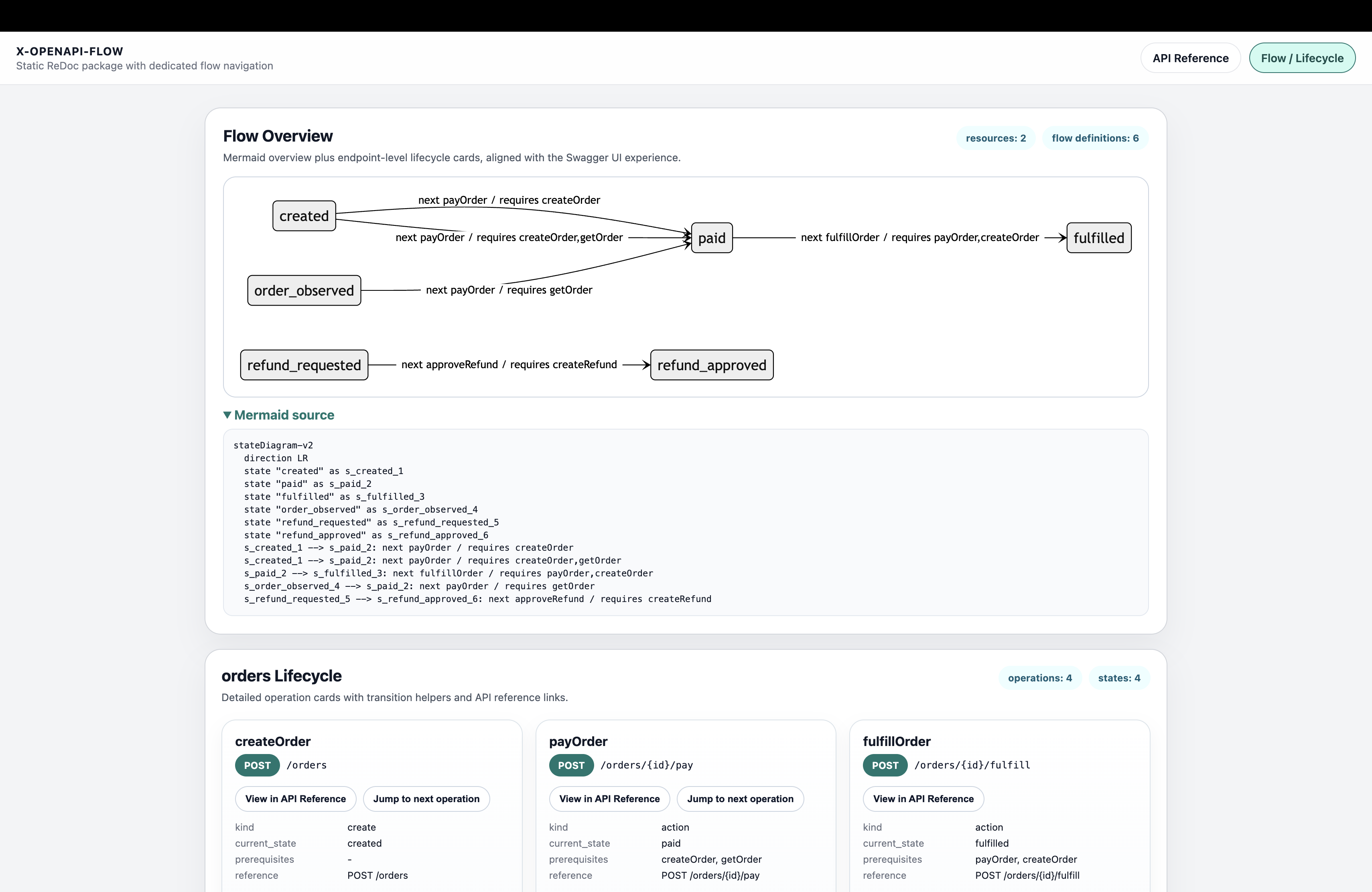
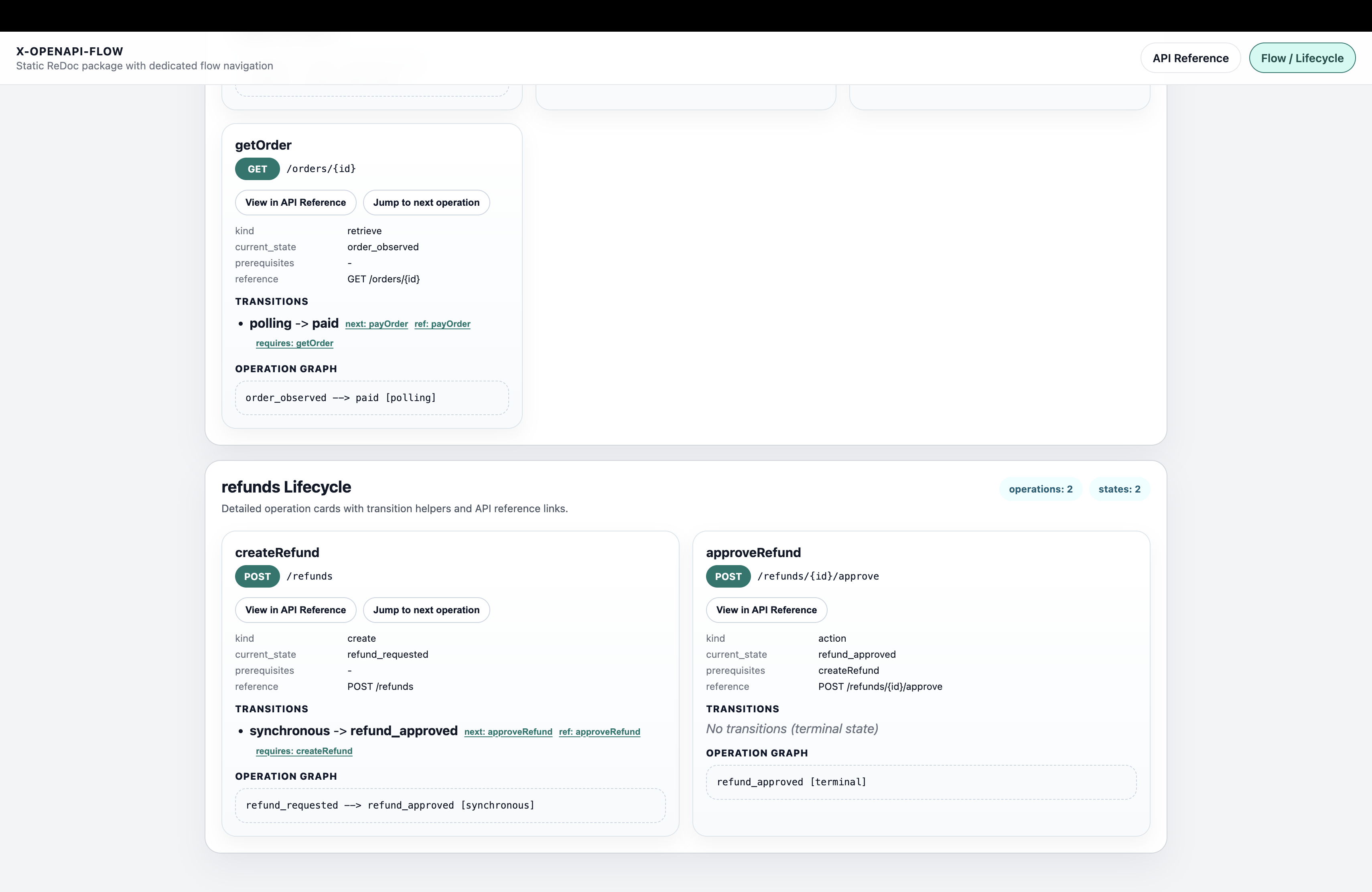
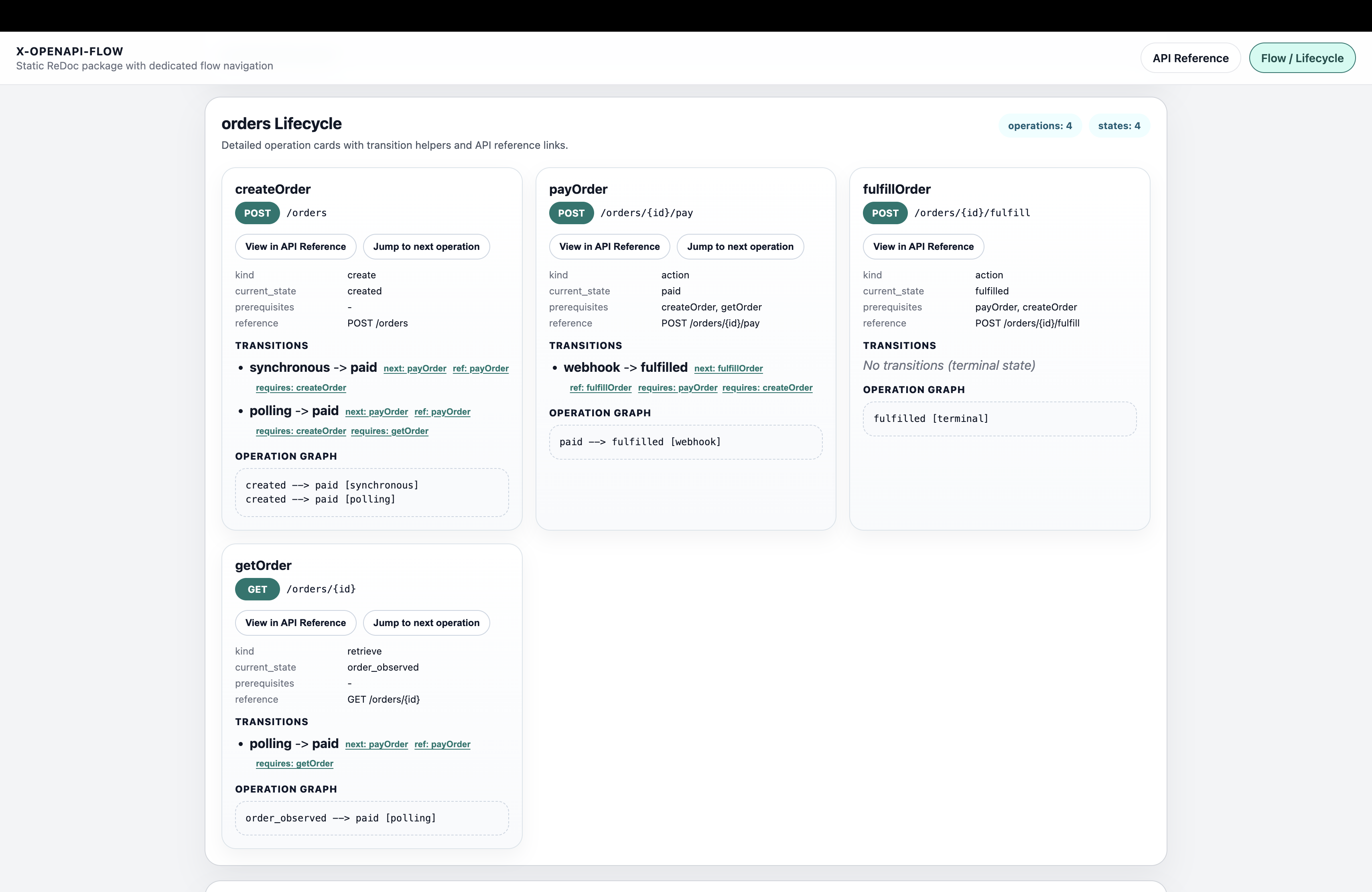
> Auto-generated lifecycle diagrams make documentation clear and consistent
<a id="postman-demo"></a>
### Postman – Organized API Collections
```bash
cd example/postman
npm install
npm run apply
npm run generate
```
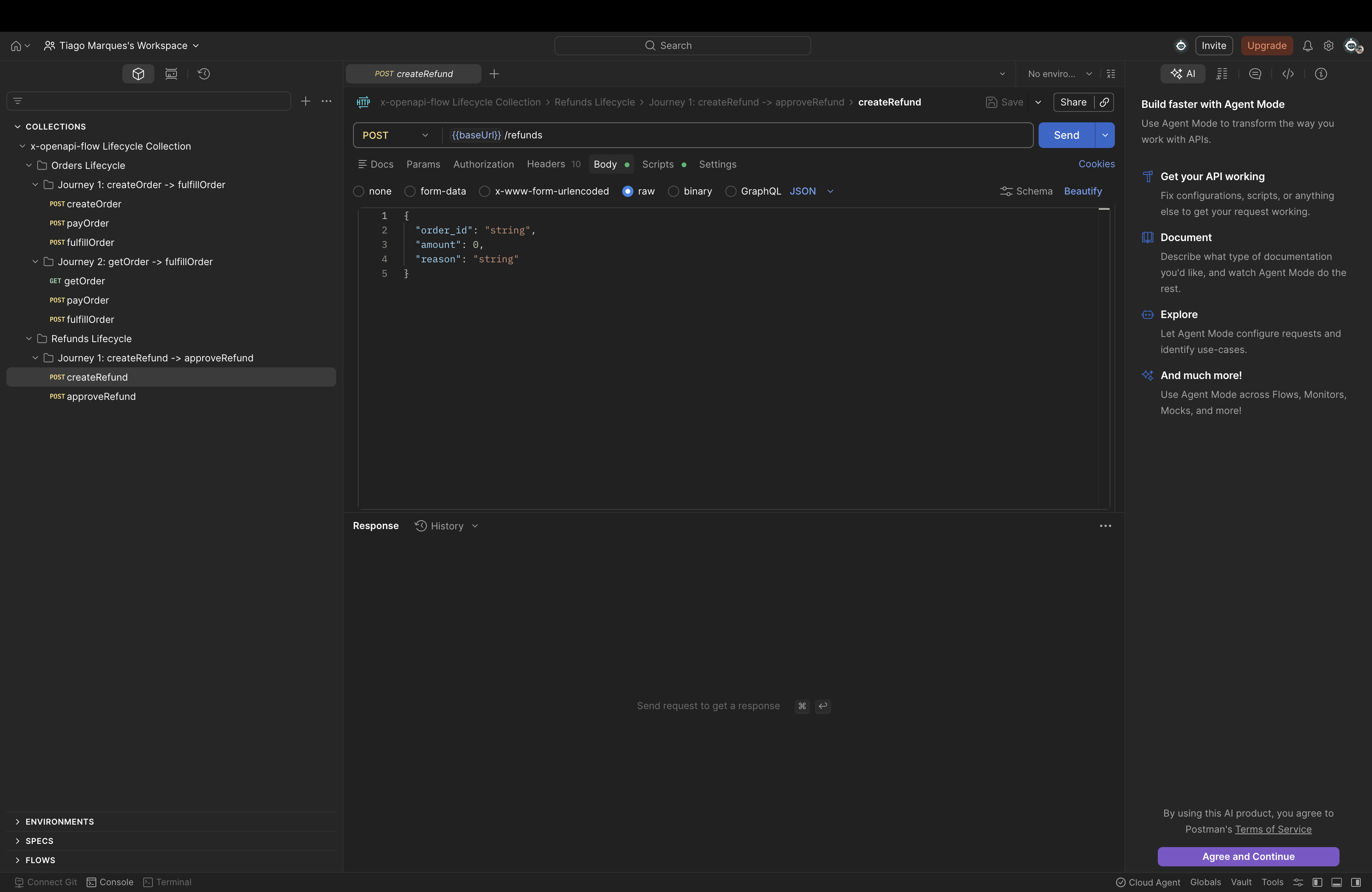
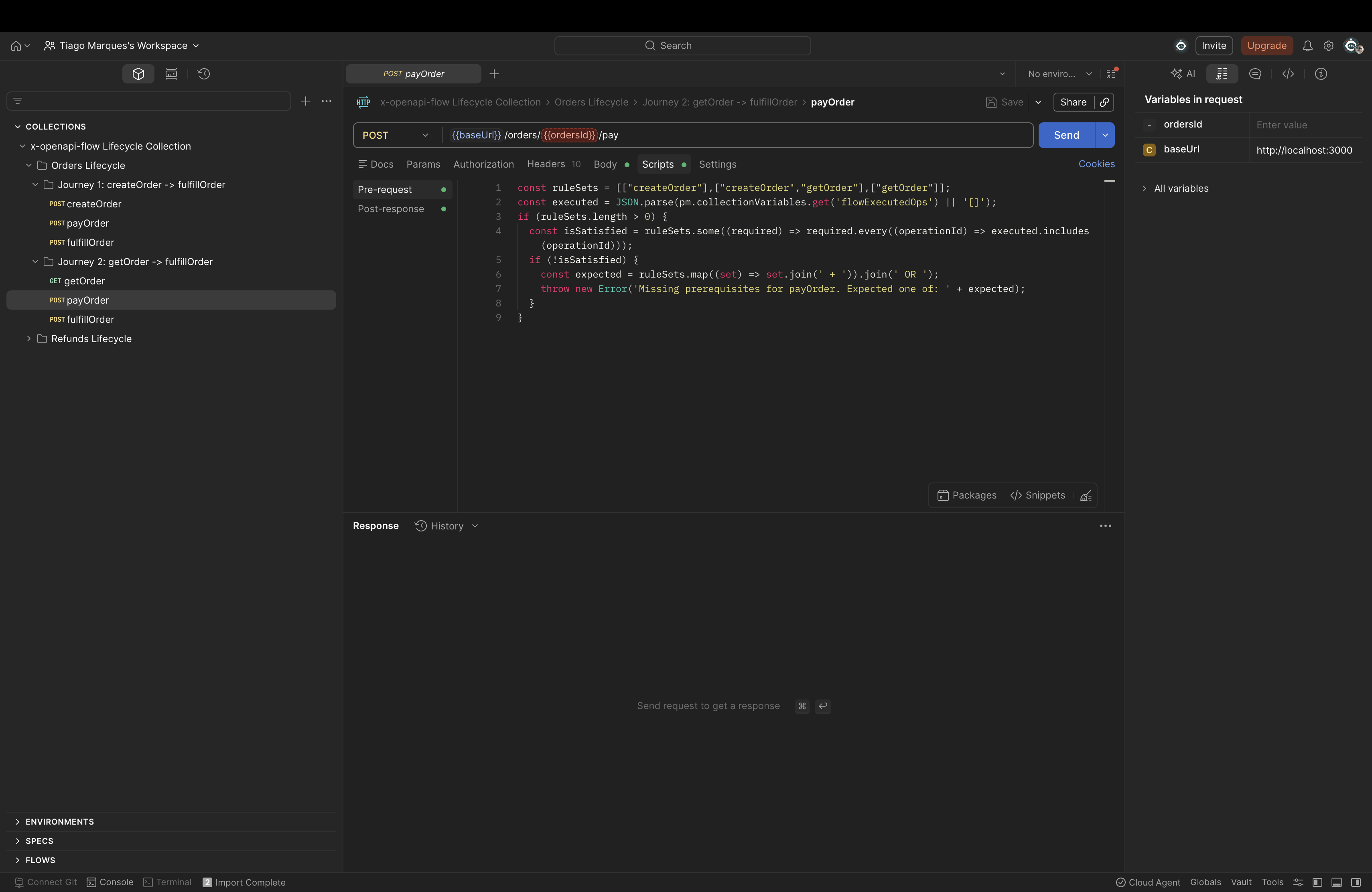
> Collections reflect lifecycle order, reducing integration errors
<a id="insomnia-demo"></a>
### Insomnia – Organized API Collections
```bash
cd example/insomnia
npm install
npm run apply
npm run generate
```
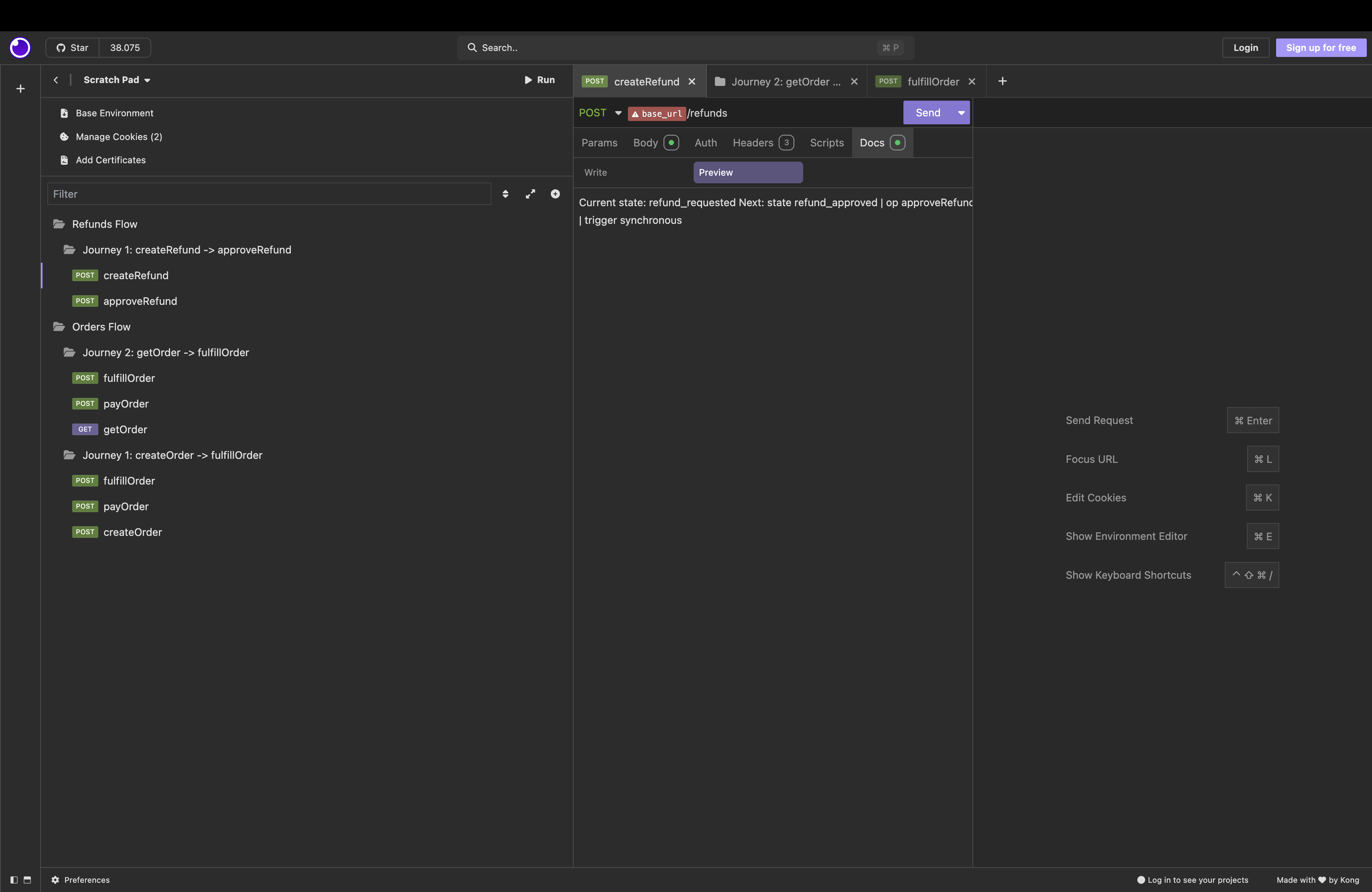
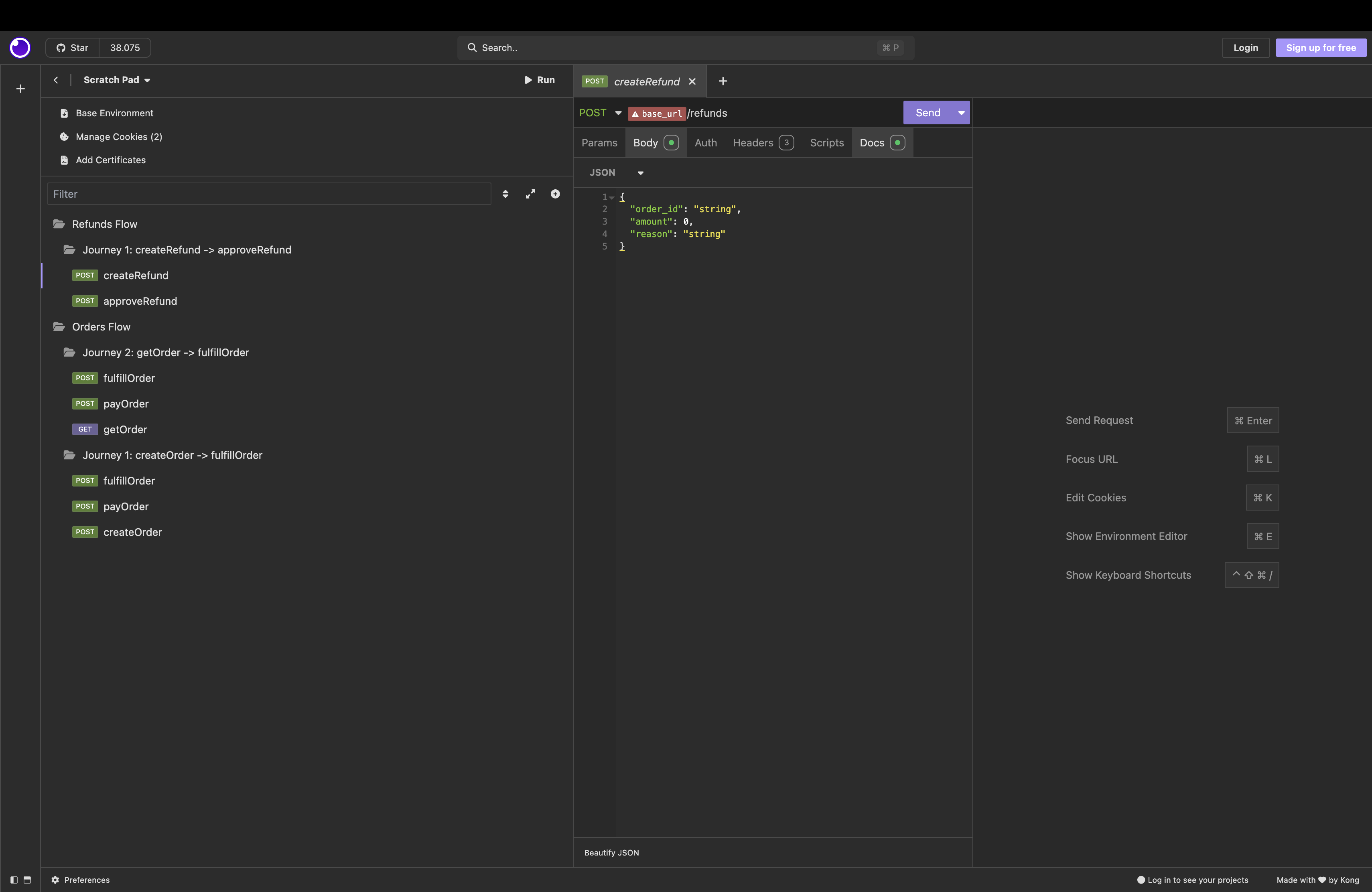
> Requests are pre-organized according to lifecycle transitions
<a id="cli-commands"></a>
## CLI Reference – Common Commands
Use x-openapi-flow from the command line to **manage, validate, visualize, and generate SDKs/docs for your API workflows**.
### General
```bash
npx x-openapi-flow help [command] # show help for a specific command
npx x-openapi-flow --help # general help
npx x-openapi-flow version # show version
npx x-openapi-flow doctor [--config path] # check setup and config
npx x-openapi-flow completion [bash|zsh] # enable shell autocompletion
npx x-openapi-flow quickstart [--dir path] [--runtime express|fastify] [--force] # scaffold runnable onboarding project
```
### Workflow Management
```bash
# initialize flow support
npx x-openapi-flow init [--flows path] [--force] [--dry-run]
# apply flows to OpenAPI
npx x-openapi-flow apply [openapi-file] [--flows path] [--out path]
# validate transitions
npx x-openapi-flow validate <openapi-file> [--profile core|relaxed|strict] [--strict-quality] [--semantic]
# preview sidecar changes
npx x-openapi-flow diff [openapi-file] [--format pretty|json]
# detect breaking flow changes (use in CI to fail PRs)
npx x-openapi-flow diff [openapi-file] --breaking-only --fail-on-breaking
```
### Visualization & Documentation
```bash
# generate lifecycle diagrams
npx x-openapi-flow graph [openapi-file] [--format mermaid|json]
# generate Redoc docs
npx x-openapi-flow generate-redoc [openapi-file] [--output path]
# export flows
npx x-openapi-flow export-doc-flows [openapi-file] [--output path] [--format markdown|json]
```
### SDK Generation
```bash
# generate flow-aware SDK
npx x-openapi-flow generate-sdk [openapi-file] --lang typescript [--output path]
```
### Test Generation
```bash
# generate executable flow tests (happy path + invalid transitions)
npx x-openapi-flow generate-flow-tests [openapi-file] [--format jest|vitest|postman] [--output path]
# postman/newman-oriented collection with flow scripts
npx x-openapi-flow generate-flow-tests [openapi-file] --format postman [--output path] [--with-scripts]
```
Full details:
- [CLI-Reference.md](https://github.com/tiago-marques/x-openapi-flow/blob/main/docs/wiki/reference/CLI-Reference.md)
- [README.md](https://github.com/tiago-marques/x-openapi-flow/blob/main/x-openapi-flow/README.md)
## NestJS Integration
Dedicated package: **x-openapi-flow-nestjs-kit**
```bash
npm install x-openapi-flow x-openapi-flow-nestjs-kit
```
Then import from `x-openapi-flow-nestjs-kit`.
This package wraps the official runtime-guard helpers and exposes a NestJS-first API.
Release automation for this package uses dedicated tags in the format `nestjs-v<version>`
(example: `nestjs-v0.1.1`) so it does not conflict with `x-openapi-flow` tags.
### Option A: Middleware (drop-in)
```ts
// flow-guard.middleware.ts
import { Injectable, NestMiddleware } from "@nestjs/common";
import { createFlowMiddleware, MemoryAdapter } from "x-openapi-flow-nestjs-kit";
import openapi from "./openapi.flow.json";
const store = new MemoryAdapter(); // swap for RedisAdapter or GenericSQLAdapter in production
const guard = createFlowMiddleware({ openapi, ...store.forGuard() });
@Injectable()
export class FlowGuardMiddleware implements NestMiddleware {
use(req: any, res: any, next: () => void) {
guard.use(req, res, next);
}
}
// app.module.ts — apply to specific routes
export class AppModule implements NestModule {
configure(consumer: MiddlewareConsumer) {
consumer.apply(FlowGuardMiddleware).forRoutes("orders");
}
}
```
### Option B: CanActivate Guard
```ts
// flow.guard.ts
import { CanActivate, ExecutionContext, Injectable } from "@nestjs/common";
import { createFlowGuard, MemoryAdapter } from "x-openapi-flow-nestjs-kit";
import openapi from "./openapi.flow.json";
const store = new MemoryAdapter();
const flowGuard = createFlowGuard({ openapi, ...store.forGuard() });
@Injectable()
export class FlowGuard implements CanActivate {
canActivate(context: ExecutionContext) {
return flowGuard.canActivate(context);
}
}
```
After each successful state-changing request, call `store.setState` to advance the resource:
```ts
@Post(":id/pay")
async pay(@Param("id") id: string) {
// … business logic …
await store.setState({ resourceId: id, state: "paid" });
return { ok: true };
}
```
## Documentation and Guides
Get the most out of x-openapi-flow with detailed guides, examples, and integration instructions:
- **Adoption Guide** – [docs/wiki/getting-started/Adoption-Playbook.md](https://github.com/tiago-marques/x-openapi-flow/blob/main/docs/wiki/getting-started/Adoption-Playbook.md)
Learn how to introduce x-openapi-flow into your API workflow efficiently
- **Troubleshooting** – [docs/wiki/reference/Troubleshooting.md](https://github.com/tiago-marques/x-openapi-flow/blob/main/docs/wiki/reference/Troubleshooting.md)
Quick solutions to common issues and validation errors
- **Real Examples** – [docs/wiki/engineering/Real-Examples.md](https://github.com/tiago-marques/x-openapi-flow/blob/main/docs/wiki/engineering/Real-Examples.md)
Explore real OpenAPI specs enhanced with lifecycle metadata
- **Integrations**:
- **GitHub Actions** – [docs/wiki/integrations/GitHub-Actions-Integration.md](https://github.com/tiago-marques/x-openapi-flow/blob/main/docs/wiki/integrations/GitHub-Actions-Integration.md)
Validate flow rules in CI in one reusable workflow step
- **Swagger UI** – [docs/wiki/integrations/Swagger-UI-Integration.md](https://github.com/tiago-marques/x-openapi-flow/blob/main/docs/wiki/integrations/Swagger-UI-Integration.md)
See flow-aware panels in Swagger UI
- **Redoc** – [docs/wiki/integrations/Redoc-Integration.md](https://github.com/tiago-marques/x-openapi-flow/blob/main/docs/wiki/integrations/Redoc-Integration.md)
Generate lifecycle diagrams in Redoc documentation
- **Postman** – [docs/wiki/integrations/Postman-Integration.md](https://github.com/tiago-marques/x-openapi-flow/blob/main/docs/wiki/integrations/Postman-Integration.md)
Organize collections according to valid transitions
- **Insomnia** – [docs/wiki/integrations/Insomnia-Integration.md](https://github.com/tiago-marques/x-openapi-flow/blob/main/docs/wiki/integrations/Insomnia-Integration.md)
Pre-configure requests according to lifecycle flows
## Community and Proof
- **Share your case study** – [docs/wiki/community/Case-Study-Template.md](https://github.com/tiago-marques/x-openapi-flow/blob/main/docs/wiki/community/Case-Study-Template.md)
- **Open discussions and ideas** – use GitHub Issues to share adoption blockers, metrics, and integration stories
: use the structured forms at [.github/ISSUE_TEMPLATE/case-study.yml](.github/ISSUE_TEMPLATE/case-study.yml) and [.github/ISSUE_TEMPLATE/adoption-blocker.yml](.github/ISSUE_TEMPLATE/adoption-blocker.yml)
- **Prove impact with metrics** – track `denied_invalid_transition`, onboarding lead time, and CI catch rate before/after adoption
## Roadmap
We’re actively expanding x-openapi-flow to support multiple platforms and SDKs. Check our progress:
- 🗂 **Roadmap Overview** – [#2](https://github.com/tiago-marques/x-openapi-flow/issues/2)
See planned features and high-level goals
- 🐍 **Python SDK MVP** – [#3](https://github.com/tiago-marques/x-openapi-flow/issues/3)
Enable Python developers to use flow-aware SDKs
- 🏎 **Go SDK MVP** – [#4](https://github.com/tiago-marques/x-openapi-flow/issues/4)
Bring lifecycle-aware SDKs to Go projects
- ☕ **Kotlin SDK MVP** – [#5](https://github.com/tiago-marques/x-openapi-flow/issues/5)
Support Android and JVM developers with flow-aware SDKs
## Changelog
Keep track of updates and improvements in x-openapi-flow:
- **Latest Version (v1.7.0)** – [CHANGELOG.md#170---2026-04-02](https://github.com/tiago-marques/x-openapi-flow/blob/main/CHANGELOG.md#170---2026-04-02)
See what shipped in the current release
- **Version History** – [CHANGELOG.md](https://github.com/tiago-marques/x-openapi-flow/blob/main/CHANGELOG.md)
Review the full version history and past updates
- **Release Notes** – [GitHub Release v1.7.0](https://github.com/tiago-marques/x-openapi-flow/releases/tag/v1.7.0)
See detailed notes for the latest release, including new features and fixes
## Documentation Language Policy
To ensure clarity and accessibility for the global developer community, **all project documentation should be written in English**. This helps contributors, users, and AI agents understand and use x-openapi-flow consistently.