ChemGlyph
Publication-quality chemical structure and reaction rendering for AI agents.
Open source Open in the app JSON README (API)
About
Publication-quality chemical structure and reaction rendering for AI agents.
Details
- Kind
- MCP servers
- Topic
- No topic detected
- Publisher
- random-orbit
- Origin
- official
- Category
- ferramentas
- Transport
- local
- Version
- 0.1.2
- Last push
- 2026-08-14T13:07:06Z
- Repository state
- ativo
- Language
- Python
- License
- MIT
- Added
- 2026-08-29 04:01:16
- Updated
- 2026-08-29 04:01:16
- Origin id
io.github.random-orbit/chemglyph
README
# ChemGlyph
Publication-quality chemical structure and reaction rendering for AI agents.
ChemGlyph is the KaTeX of chemistry: a rendering layer, a validation layer,
and an MCP interface on top of [RDKit](https://www.rdkit.org).
[](https://github.com/chemglyph/chemglyph/actions/workflows/ci.yml)
## Install
```bash
pip install chemglyph
```
## Render a molecule
```python
import chemglyph
result = chemglyph.render_molecule("c1ccccc1") # benzene
open("benzene.svg", "w").write(result.data)
```
`render_molecule` takes SMILES, InChI, or molblock and returns SVG (or PNG)
plus `canonical_smiles`, `mol_formula`, `mol_weight`, and `warnings`.
## Styles
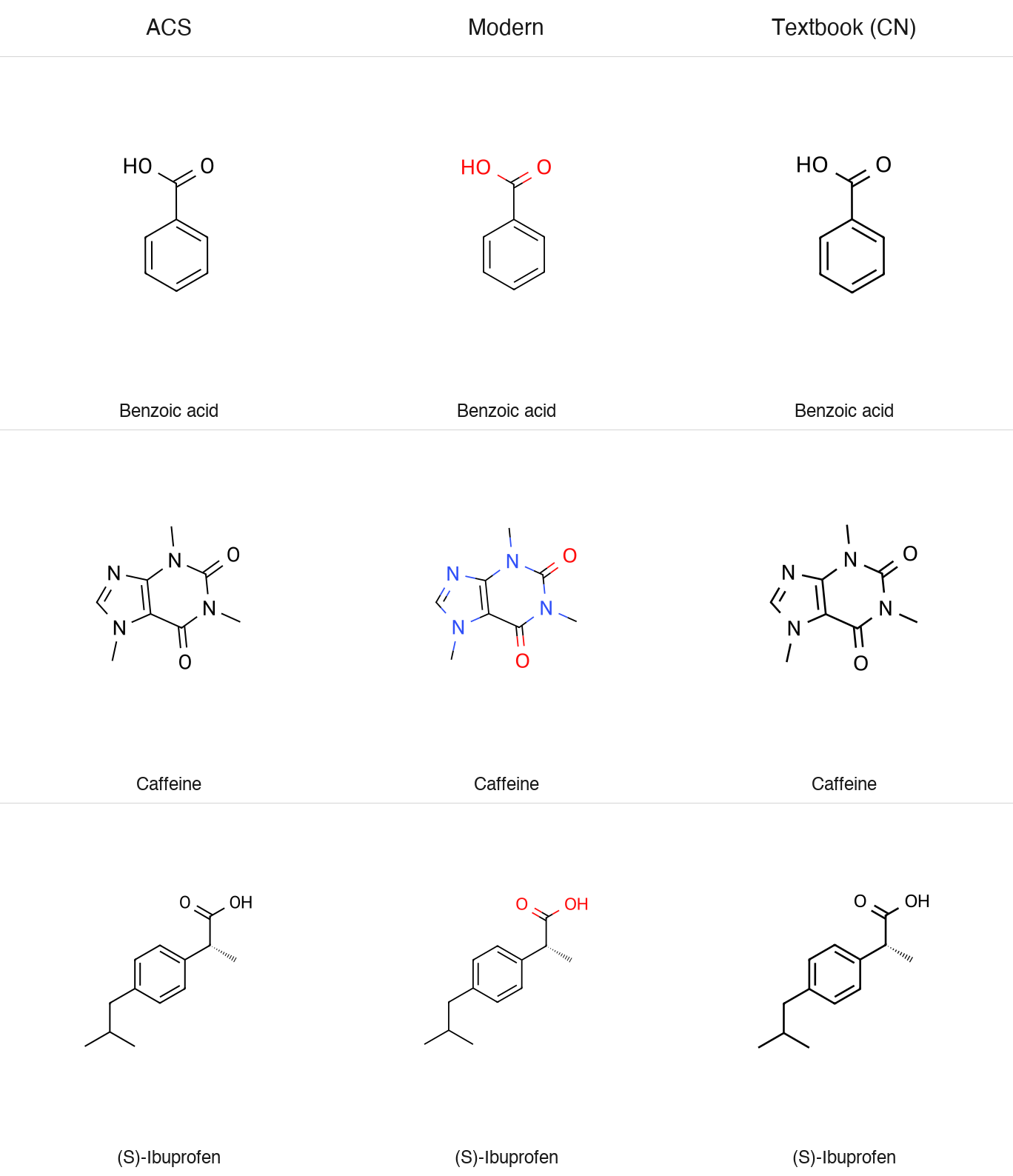
Three styles, same molecule (benzoic acid, caffeine, (S)-ibuprofen):
```python
chemglyph.render_molecule(smiles, style="acs") # black/white, ACS journal
chemglyph.render_molecule(smiles, style="modern") # colored heteroatoms, screens
chemglyph.render_molecule(smiles, style="textbook-cn") # bold monochrome, textbook
```
All styles default to a transparent background (`transparent=True`) and
support `fmt="png"`.
## Reactions
```python
spec = {
"steps": [
{
"reactants": ["OC(=O)c1ccccc1O", "CC(=O)OC(C)=O"],
"products": ["CC(=O)Oc1ccccc1C(=O)O", "CC(=O)O"],
"conditions": {"above": "H₂SO₄ (cat.)", "below": "rt, 15 min"},
"yield": "89%",
"arrow": "forward",
}
],
"style": "modern",
}
svg = chemglyph.render_reaction(spec)
```
Conditions are pre-formatted Unicode text, so pass `H₂SO₄`, not `H2SO4`.
ChemGlyph does not parse formulas out of text. The full schema
(multi-step chains, equilibrium and retro arrows, line wrapping) is in
[docs/reaction_schema.md](docs/reaction_schema.md).
The aspirin demo writes a two-step route:
```bash
python examples/aspirin_synthesis.py # writes examples/aspirin_synthesis.svg
```
## Validation
`validate_structure` reports parse errors and applies four quick fixes:
unmatched brackets and ring closures (reported, not guessed), kekulization
failures of lowercase aromatic atoms, and nitrogen valence errors via a
formal `[N+]`. Anything else passes RDKit's message through unchanged.
```python
report = chemglyph.validate_structure("c1cccc1")
report.fixes[0].description # 'lowercase aromatic atoms could not be kekulized...'
report.fixes[0].fixed_smiles # 'C1CCCC1'
```
## Naming
```python
chemglyph.parse_name("aspirin") # 'CC(=O)Oc1ccccc1C(=O)O'
```
English IUPAC and common names resolve offline through OPSIN
(`pip install 'chemglyph[opsin]'`, plus a Java runtime). Chinese names use
the built-in dictionary, and the library API accepts a translator callable
for names that are not in it:
```python
chemglyph.parse_name("阿司匹林") # 'CC(=O)Oc1ccccc1C(=O)O'
chemglyph.parse_name("六甲基苯", translator=to_english)
```
ChemGlyph itself never calls an online service, including for translation.
## MCP server
Run the bundled console script (stdio transport):
<!-- mcp-name: io.github.random-orbit/chemglyph -->
```bash
chemglyph-mcp
```
Claude Desktop registration (macOS:
`~/Library/Application Support/Claude/claude_desktop_config.json`):
```json
{
"mcpServers": {
"chemglyph": {
"command": "chemglyph-mcp"
}
}
}
```
| Tool | Use it when | Returns |
|---|---|---|
| `render_molecule` | the user asks to draw one structure from SMILES/InChI/molblock | PNG image plus formula, MW, warnings (SVG source on request) |
| `render_reaction` | the user asks for a reaction or synthesis route | PNG image of the reaction scheme |
| `validate_structure` | a SMILES may be malformed and you need a repair | validation report JSON |
| `parse_name` | the user gives a name like "aspirin" instead of SMILES | canonical SMILES or an error |
One thing to know about clients. Some MCP clients, LM Studio included, only
pass the text part of a tool result to the model and never display the
attached image. The render tools write their PNG to `~/Downloads/chemglyph/`
and return that path in the text, so you can always open the file yourself.
If a model claims it rendered a figure but nothing shows up, ask it for the
saved path rather than having it redraw the structure by hand.
## Benchmarks
`benchmarks/` holds the fixed 20-molecule blind test and a generator that
writes shuffled, numbered PNG/SVG figures plus `answer_key.json`:
```bash
python benchmarks/generate_blind_test.py --seed 1234
```
The deck, methodology, and scoring tooling are all open-sourced: the fixed
molecule list, the A/B deck generator (which pairs ChemGlyph against an
open-source reference renderer), the runbook, and the scorer live in
[benchmarks/](benchmarks/). Anyone can run the protocol and contribute
results. The pass threshold and procedure are documented in
[benchmarks/RUNBOOK.md](benchmarks/RUNBOOK.md).
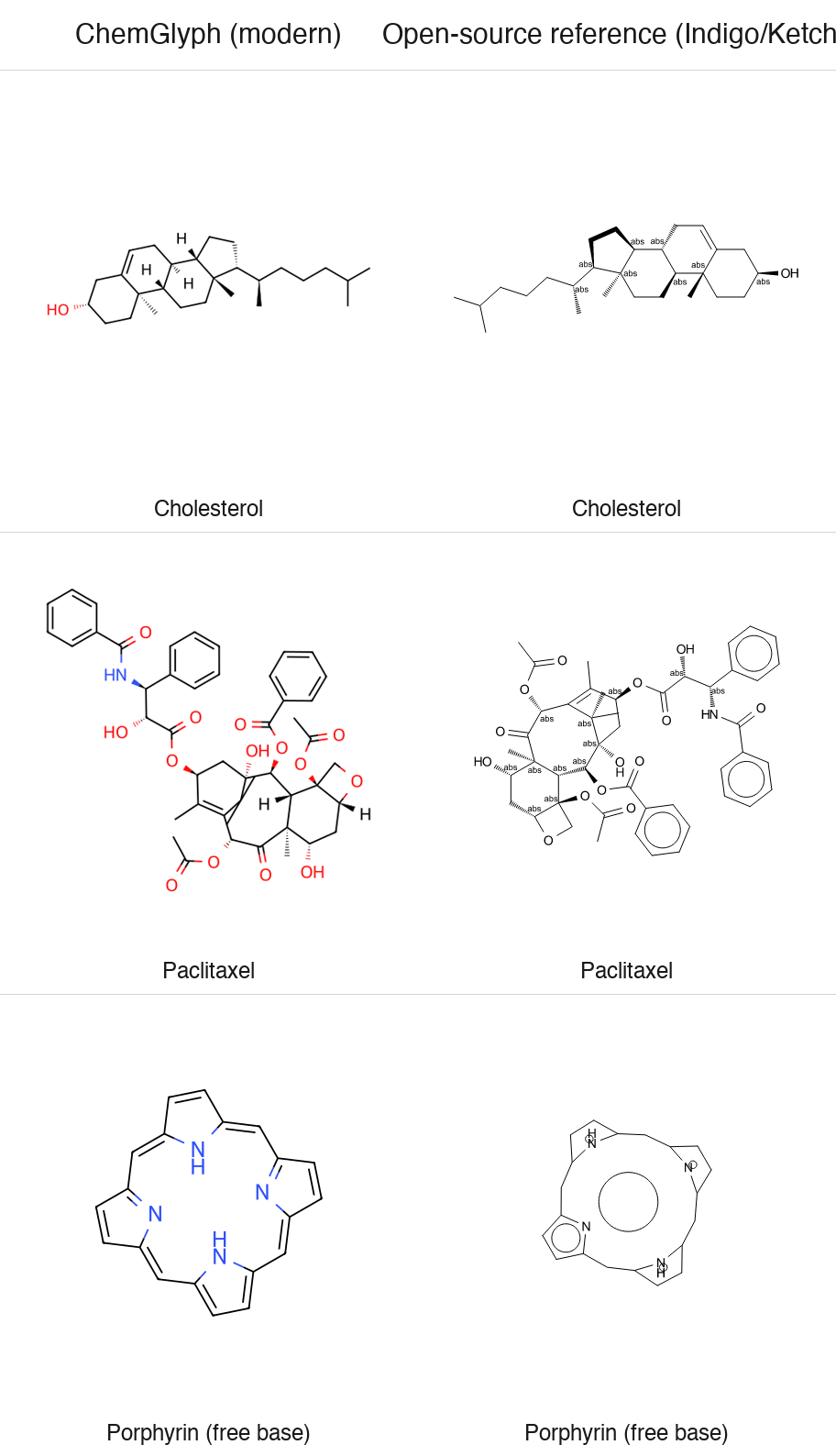
Blind test vs ChemDraw: pending. The image above is an author-generated
comparison of ChemGlyph `modern` against the open-source reference renderer
(Indigo, the engine behind Ketcher) - it is not an independent review.
## Known limitations
- Blind-test figures for ferrocene (metal complex) and the free-base
porphyrin (large conjugated macrocycle) are excluded from the benchmark
denominator and recorded separately.
- RDKit has no clean 2D layout for paclitaxel: its gem-dimethyl substituent
placement inside the central 8-membered ring is a documented layout
limitation.
- Full automatic Chinese name-to-structure parsing is not implemented;
Chinese names resolve through a small built-in dictionary plus an optional
translator hook. English names resolve through OPSIN.
## Roadmap
- v0.2: Chinese naming (built-in dictionary plus translator hook), down-arrow
line wrapping, arrow column alignment, cropped fragments. All shipped.
- Next: mechanism (electron-pushing) arrows, see
[docs/progress/v02-research.md](docs/progress/v02-research.md).
- Later: a larger Chinese dictionary as an optional data extra.
## Non-goals
No structure editor GUI (Ketcher/ChemDraw competition), no 3D visualization,
no retrosynthesis or property prediction, no online database queries, and no
automatic mechanism generation. The full list is in the project
specification.
## Development
```bash
python -m venv .venv
.venv/bin/pip install -e ".[dev]"
.venv/bin/ruff check . && .venv/bin/ruff format . && .venv/bin/pytest
```
Python 3.11+, RDKit 2024.9+, MIT license. All errors derive from
`chemglyph.errors.ChemGlyphError`.