io.github.activeing123/mcptoon
Zero-dependency MCP client: one synced config for every agent, 581-token listings, not 71,929.
Open source Open in the app JSON README (API)
About
Zero-dependency MCP client: one synced config for every agent, 581-token listings, not 71,929.
Details
- Kind
- MCP servers
- Topic
- Developer tools
- Publisher
- activeing123
- Origin
- official
- Category
- ferramentas
- Transport
- local
- Version
- 0.7.5
- Stars
- 197
- Forks
- 7
- Last push
- 2026-09-12T12:51:27Z
- Repository state
- ativo
- Language
- HTML
- License
- Apache-2.0
- Added
- 2026-08-30 13:01:03
- Updated
- 2026-09-05 10:00:27
- Origin id
io.github.activeing123/mcptoon
README
<!-- mcp-name: io.github.activeing123/mcptoon -->
<div align="center" markdown="1">
# mcptoon
**Add 1,000 MCP tools locally — your token context never feels it.**
mcptoon is a CLI tool that sits between your AI agent and your MCP servers. Hook up as
many servers as you want — the agent's context window stays clean. Token savings happen
in two separate places; don't mix them up:
- **Tool discovery (saves by default, zero action)**: `mcptoon manifest` sends only the
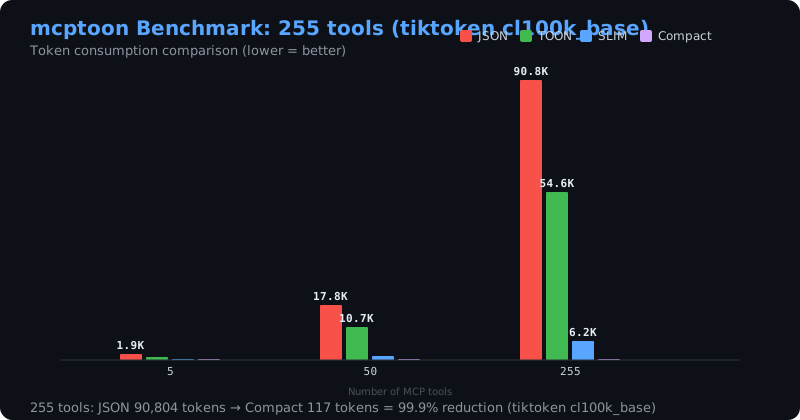
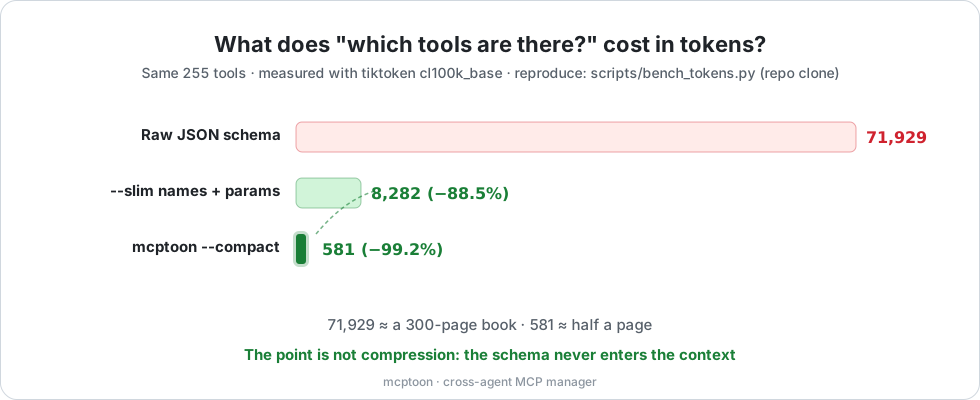
name list; schemas stay on disk — 255 tools drop from 71,929 to 581 tokens, −99.2%.
- **Call results (optional)**: `mcptoon call` returns JSON by default; add `--toon` to
shrink results by ~34% vs JSON (measured).
**Mcptoon is the native decoupling layer for MCP tools.** It fixes the twin pain of
MCP tool listings eating tokens and every AI agent re-configuring tools on its own.
Built on agents' native CLI-calling ability: zero config, out of the box, it
auto-scans and unifies the MCP tools of every agent on this machine, shares tool
instances globally, and slashes token overhead.
**Your tools stay yours.** mcptoon bundles nothing — it's a 128KB CLI, like a remote
control. The MCP servers you want, you install yourself, one command each
(npm/pip/a URL). Delete mcptoon someday? Your MCP servers keep running on their own —
not one goes missing.
Savings start the moment you use it: 99.2% off tool discovery (measured), and every
agent on this machine that can run a shell command — Claude Code, Cursor, Codex,
scripts, CI — gets your full toolkit with no extra setup.
[](https://pypi.org/project/mcptoon/)
[](https://github.com/activeing123/mcptoon/actions/workflows/ci.yml)
[](#contributing)
[](https://modelcontextprotocol.io/specification/2026-07-28)
[](https://github.com/activeing123/mcptoon/blob/main/LICENSE)
**👉 `pip install mcptoon`** · [中文](https://github.com/activeing123/mcptoon/blob/main/README.zh-CN.md) · [Developer docs](https://github.com/activeing123/mcptoon/blob/main/DEVELOPERS.md) · [Issues](https://github.com/activeing123/mcptoon/issues)
</div>
---
## This isn't just us talking
Those numbers are ours, but "loading every tool schema into context is expensive" is
not a claim only we make:
- [Anthropic](https://www.anthropic.com/engineering/code-execution-with-mcp): tool
schemas flooding the context window is a real pain — one example drops from 150,000
tokens to 2,000 (a 98.7% saving)
- [Firecrawl benchmark](https://www.firecrawl.dev/blog/mcp-vs-cli): the same task cost
1,365 tokens via CLI vs 44,026 via MCP — 32× (full schema loaded upfront)
- [Scalekit benchmark](https://www.scalekit.com/blog/mcp-vs-cli-use): CLI is 10–32×
cheaper and 100% reliable; MCP scores 72%
- [MCP-Zero (arXiv:2506.01056)](https://arxiv.org/abs/2506.01056): on-demand tool
retrieval achieves near-constant cost regardless of tool count
- [SEP-1576](https://github.com/modelcontextprotocol/modelcontextprotocol/issues/1576):
an open MCP proposal to cut schema redundancy — the problem is acknowledged upstream
We're not the only ones who measured this. mcptoon is the one you can use today,
covering every agent at once.
---
## Up and running in 30 seconds
```bash
pip install mcptoon # pure stdlib, 128KB, zero dependencies
# Add any MCP server — one command:
mcptoon add fetch --stdio npx -y @modelcontextprotocol/server-fetch
# See every tool available (names-only by default; 255 tools cost 581 tokens):
mcptoon manifest
# Call a tool (JSON output by default; add --toon to save more):
mcptoon call fetch fetch '{"url":"https://example.com"}'
```
**Or let mcptoon auto-discover servers already on your machine:**
```bash
mcptoon quickstart # discover + configure + list tools — one command
```
That's it. No hand-written JSON config. No MCP protocol debugging. No polluted context
window.
---
## The problem
Every MCP agent (Claude Code, Cursor, Codex, …) stuffs **every tool's full schema into
your context window** before doing any work:
```
50 tools → 14,113 tokens of schema → a 128K context: 11% gone
255 tools → 71,929 tokens of schema → a 128K context: 56% gone
```
So you unload servers you aren't using and reload them when you are. Back and forth.
Adding one new server still means hand-writing a JSON config — one missing comma and
everything breaks.
**mcptoon fixes this.** Your MCP servers stay configured, but their schemas **never
enter the agent's context by default**. The agent just runs `mcptoon` commands, and
only the compact result you asked for enters context — the name index weighs 581
tokens (114 for 50 tools, −99.2%).
```
Without mcptoon: 255 tools → 71,929 tokens, over half the window
With mcptoon: 255 tools → 581 tokens. 99.2% saved.
```
*Both rows are measured configurations, not one number scaled up and down (tiktoken
`cl100k_base`, `assets/benchmark_tiktoken.json`). Your mix will differ —
[compute your own numbers in the browser](https://activeing123.github.io/mcptoon/tools/token-tax/),
30 seconds, nothing uploaded.*
---
## Installing MCP servers — one command each
```bash
# Install from npm (most MCP servers live here):
mcptoon install brave-search --npm @modelcontextprotocol/server-brave-search
# Install from pip:
mcptoon install my-tool --pip mcp-my-tool
# HTTP/SSE servers:
mcptoon install remote-api --url https://example.com/mcp
# List installed:
mcptoon install --list
# Uninstall:
mcptoon install --remove brave-search
```
mcptoon connects, discovers tools, generates the handler, registers it. No restart
needed.
**Any MCP server works:**
```bash
mcptoon add my-server --stdio npx -y @any/mcp-package
mcptoon manifest # usable immediately
```
---
## Prefer a GUI? ToonDeck
Don't want to hand-edit configs? **[ToonDeck](https://github.com/activeing123/toondeck)**
is a local console for mcptoon: every MCP server and tool in one place with a
real health check, one skill folder synced to all your agents, agent launching
with live logs, and API keys stored in your OS keychain — never in a plaintext
file.
```bash
pip install toondeck # ships the web UI inside the wheel — no node, no build
```
Pre-alpha; free (Apache-2.0). ToonDeck drives the engine — mcptoon stays the
single source of truth underneath.
---
## Works with every AI agent
mcptoon is a CLI. **If your agent can run a shell command, it can use mcptoon.** No
plugins, no SDK, no per-agent setup.
| Agent | How |
|---|---|
| **Claude Code** | put `mcptoon` commands in SKILL.md |
| **Codex (OpenAI)** | add `mcptoon` to AGENTS.md |
| **Cursor** | add `mcptoon` to .cursorrules |
| **OpenCode** | use `mcptoon` in custom commands |
| **Any agent** | can run shell commands → can call `mcptoon` |
Configure once in `~/.mcptoon/config.json`; every agent that can run shell commands
shares the same servers and tools. GUI agents that can't? `mcptoon sync` writes native
JSON into each one's own location.
```bash
export MCPTOON_AGENT_TYPE=claude # call results auto-select --toon
# export MCPTOON_AGENT_TYPE=openai # or keep the default JSON
```
Your AI can even add tools by itself — no human in the loop:
```bash
# Agent needs GitHub access mid-task? It just runs:
mcptoon add github --stdio npx -y @modelcontextprotocol/server-github
mcptoon call github search_repos '{"query":"mcp"}'
# Done. No JSON editing. No restart. No lost context.
```
---
## The numbers
mcptoon's token savings are two separate bills — know which one you're reading before
comparing numbers.
### Bill 1 · Tool discovery (`manifest`): 99.2% saved by default
This bill comes due **before your agent decides "which tool do I use"**. Native MCP
shoves every tool's full schema into context (50 tools: 14,113 tokens; 255 tools:
71,929 tokens). mcptoon sends only the name index — that's where "114, not 14,113"
comes from.
| Tools | Native schema (JSON) | mcptoon name index (default) | Saved |
|-------|-------------------|------------------------|-------:|
| 5 | 1,519 | 11 | −99.3% |
| 50 | 14,113 | **114** | **−99.2%** |
| 255 | 71,929 | **581** | **−99.2%** |
Zero action, on by default: `mcptoon manifest` with no flags is this tier.
Want to give the agent more? `--full` (names + parameter types) saves 88.5%;
`--json` (full schema) is the baseline.
*Both rows are measured configurations, not one number scaled up and down (tiktoken
`cl100k_base`, `assets/benchmark_tiktoken.json`). Your mix will differ —
[compute your own numbers in the browser](https://activeing123.github.io/mcptoon/tools/token-tax/),
30 seconds, nothing uploaded.*
### Bill 2 · Call results (`call`): optional, --toon saves ~34%
This bill comes due **after a tool returns its result to your agent**. `mcptoon call`
outputs JSON by default — yes, the default saves nothing. To shrink results too, add
`--toon` (structured encoding, reversible):
```
Default: mcptoon call fetch fetch '{"url":"https://example.com"}' → JSON (baseline)
Leaner: mcptoon call fetch fetch '{"url":"https://example.com"}' --toon → ~34% saved
```
34% is the measured `toon_save` value in `assets/benchmark_tiktoken.json`
(34.0–34.2%), not a marketing number.
**One line to remember: 99.2% is what you save seeing which tools exist; 34% is what
you can further save on results.**
### Side-by-side (Bill 1, made visible)
**Without mcptoon** (what every MCP client stuffs into context — 37 tokens, measured
with tiktoken):
```json
[{"name":"search_web","description":"Search the web for information",
"inputSchema":{"type":"object","properties":{"query":{"type":"string","description":"Search query"}}}}]
```
**With mcptoon** (2 tokens):
```
search_web
```
**With mcptoon --full** (6 tokens, parameter info included):
```
search_web|query:s*
```
---
## Security
Three layers, all built in:
| Layer | What it does | Example |
|-------|-------------|---------|
| **Destructive-action block** | dangerous actions blocked unless you pass `--destructive` | `db query '{"sql":"DROP TABLE users"}'` → blocked |
| **Prompt-injection guard** | scans results for injection patterns | `"ignore previous instructions"` → blocked |
| **Credential-leak detection** | scans results for exposed keys/tokens | `sk-abc...xyz` → blocked, never enters agent context |
- **No telemetry.** No analytics, no crash reports, no call-home.
- **No stored credentials.** API keys pass straight from your config or environment.
- **No dependencies.** Pure Python standard library. Nothing in the supply chain to audit.
- **No daemon.** Pure CLI — no resident process, no listening port, no attack surface.
---
## All commands
```bash
mcptoon quickstart # one-shot start (discover + configure + list tools)
mcptoon list # show configured servers
mcptoon manifest # all tool names (compact by default; 255 tools = 581 tokens)
mcptoon manifest --full # tool schemas with params (88.5% smaller than native)
mcptoon inspect <server> <tool> # inspect one tool's schema
mcptoon search <query> # search tools across servers
mcptoon call <server> <tool> '{"args":"here"}' # call a tool
mcptoon call --auto <tool> '{"args":"here"}' # auto-find the server
mcptoon call <server> <tool> --stdin # read large args from stdin
mcptoon add <name> --stdio|--http <cmd|url> # add any MCP server
mcptoon remove <name> # remove a server
mcptoon install <name> --npm|--pip|--url <pkg> # install + auto-generate handler
mcptoon install --list # list installed
mcptoon install --remove <name> # uninstall
mcptoon sync # sync native config to every detected agent
mcptoon plugin install <dir> # install an Agent Plugins 1.0.0 plugin
mcptoon serve # run as an MCP server (stdio/HTTP)
mcptoon demo # one command, live demo on your machine
mcptoon doctor # self-check: Python, config, connectivity
mcptoon usage # local call statistics
mcptoon completion ps # shell completion (bash/zsh/fish/powershell)
```
### Format family: four tiers, compact by default
Discovery and call results each have a set of formats — all optional, and the default
is already the leanest tier:
**manifest (discovery): compact by default, upgrade only if you want more**
| Tier | Output | vs native schema | Origin |
|---|---|---|---|
| **compact (default)** | names only `search_web` | **99.2% smaller** | common design |
| **slim** | name + param types `search_web\|query:s*` | 88.5% smaller | **mcptoon original** |
| **full** | full schema with params | baseline | native MCP |
**Why compact by default, not full?** Deciding "which tool do I use" only needs names
(581 tokens for 255 tools); parameter details matter at call time, fetched on demand
via `inspect` or `manifest --full`. Defaulting to full schemas hands the 99.2% right
back.
**call (results): JSON by default, --toon to save**
| Tier | Output | vs JSON | Origin |
|---|---|---|---|
| **(default)** | JSON | baseline | common |
| **--toon** | structured encoding (reversible) | ~34% smaller | open TOON standard |
| **--mcptoon** | legacy pipe format | — | mcptoon original (legacy) |
**Where these formats come from**
- **compact**: a name list — any tool manager can do it; nothing proprietary.
- **slim** (`name|param:type*` signatures): **an mcptoon original**, implemented in
`output.py` (`slim_toon`, Apache 2.0); noted in NOTICE.
- **full**: full JSON Schema — what MCP speaks natively.
- **toon** (result encoding): integration of the open **TOON standard**
([toon-format/toon](https://github.com/toon-format/toon) v4.1, MIT), vendored from
python-toon and credited in NOTICE — not our invention, and we don't claim it.
---
## Do custom formats break MCP compatibility? — No, for three reasons
"Proprietary format = compatibility bomb" is a fair worry. It doesn't apply here:
**1 · The protocol layer is always standard JSON-RPC; formats live only in the
presentation layer.**
mcptoon speaks standard MCP to servers (`initialize` / `tools/list` / `tools/call`).
compact/slim/toon only affect the "mcptoon → agent" output rendering — not a single
byte toward the server. Servers always see standard JSON; they don't even know these
formats exist.
**2 · --toon isn't proprietary; it's an open standard.**
TOON (Token-Oriented Object Notation) is an external open standard
([toon-format/toon](https://github.com/toon-format/toon) v4.1, MIT, official
TypeScript reference implementation). We integrate python-toon (MIT);
`tests/test_toon_cross_validate.py` verifies `decode(encode(x)) == x` case by case.
**3 · There's a fallback; worst case you fall back to JSON.**
If `--toon` decoding fails it falls back to JSON automatically (`--fallback-json`);
and call results are JSON by default anyway — `--toon` is optional. Want the full
schema back? One `--full` is native MCP. No lock-in.
**In one line: zero protocol changes, formats live in the output layer, worst case
falls back to JSON.** The feared "server can't understand the custom format" can't
happen — servers always hear standard JSON-RPC.
---
## How it works
mcptoon is a **CLI tool**, not an MCP client library. Your agent doesn't connect to
MCP servers — it runs `mcptoon` commands. Schemas live on disk in
`~/.mcptoon/config.json`, out of the context window by default.
**Two-layer decoupling:**
```
Layer 1: mcptoon CLI (128KB, zero deps)
runs in the agent's shell. schemas stay out of context by default.
│
Layer 2: the actual MCP servers (npm/pip packages)
start only when a tool is called. Zero cost when idle.
```
- 1,000 servers configured → 0 running, until you call one
- mcptoon bundles nothing — you add what you want, one command each
- Delete mcptoon? Your MCP servers keep running independently
---
## Why a CLI, not a proxy
MCP's premise: every capability is a *server*, and your agent must be configured to
reach it. That premise is why one new tool means editing per-agent JSON in a different
format for each, restarting everything — and why every agent re-pays the full schema
cost before doing anything.
A command line is the one interface every agent already has. And the form factor is
measurably cheaper, independent of anything mcptoon does:
- Firecrawl's benchmark: the same task cost **1,365 tokens via CLI vs 44,026 via MCP — 32×**
- Scalekit's benchmark: CLI **10–32× cheaper, 100% reliable vs MCP's 72%**
If you truly need the proxy form, `mcptoon serve` is that mode — all configured
servers behind one MCP endpoint, with connection pooling and per-agent API keys.
---
## Contributing
```bash
git clone https://github.com/activeing123/mcptoon.git
cd mcptoon
pip install -e . --no-build-isolation
pip install pytest pytest-cov
python -m pytest tests/ -v # 738 passed, 1 skipped
```
Zero dependencies is a hard rule. New features need tests. See
[CONTRIBUTING.md](https://github.com/activeing123/mcptoon/blob/main/CONTRIBUTING.md) and [DEVELOPERS.md](https://github.com/activeing123/mcptoon/blob/main/DEVELOPERS.md).
The codebase: 11,400 lines of Python across 21 modules, zero third-party dependencies.
---
<div align="center">
*mcptoon is an independent third-party MCP client, not affiliated with Anthropic.*
**If this helps you, star it so more people can find it.**
</div>