{
"markdown": "# ZettelForge\n\n\n\n**The only agentic memory system built for cyber threat intelligence.**\n\nWhen a senior analyst leaves, two or three years of context walks out with them — customer environments, prior investigations, actor TTPs, false-positive patterns, every hard-won \"wait, we've seen this before.\" ZettelForge is an agentic memory system built so that context stays with the team.\n\nIt extracts CVEs, threat actors, IOCs, and ATT&CK techniques from analyst notes and threat reports, resolves aliases (APT28 = Fancy Bear = STRONTIUM = Sofacy), builds a STIX 2.1 knowledge graph, and serves every past investigation back to your analysts — and to Claude Code via MCP — in natural language. Runs entirely in-process. No API keys. No cloud. No data leaves the host.\n\n[](https://pypi.org/project/zettelforge/)\n[](https://pepy.tech/projects/zettelforge)\n[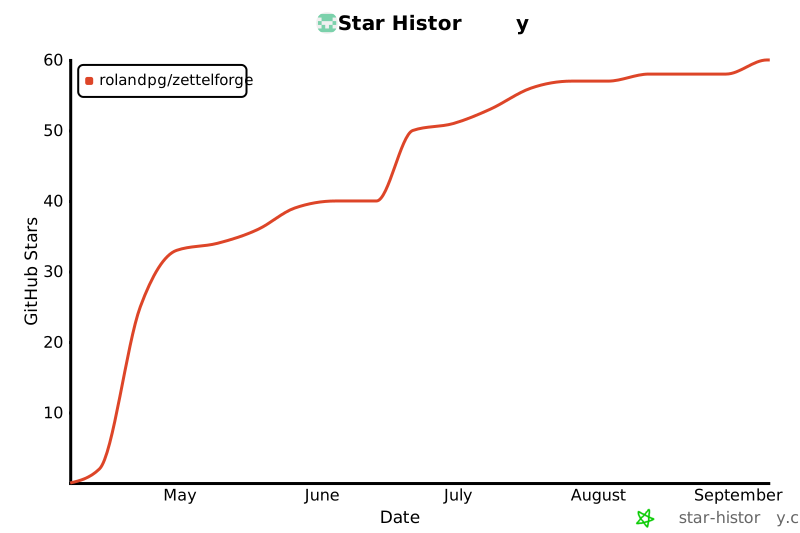](https://star-history.com/#rolandpg/zettelforge&Date)\n[](https://www.python.org/downloads/)\n[](https://opensource.org/licenses/MIT)\n[](https://github.com/rolandpg/zettelforge/actions)\n[](https://github.com/rolandpg/zettelforge/issues)\n[](https://deepwiki.com/ThreatRecall/zettelforge)\n\n**[Star](https://github.com/rolandpg/zettelforge) · [`pip install zettelforge`](https://pypi.org/project/zettelforge/) · [Docs](https://docs.threatrecall.ai/) · [ThreatRecall (hosted)](https://threatrecall.ai) · [Changelog](CHANGELOG.md)**\n\n> **v2.6.2** (2026-04-27): Config web editor ships with working dropdowns for all enum fields (LLM/embedding provider, log level, PII action, synthesis format) and a working Apply button. New `[crewai]` extra exposes ZettelForge as CrewAI tools -- `pip install zettelforge[crewai]`. [Full changelog](CHANGELOG.md)\n\n
\n \n
\n\n> If ZettelForge fits a CTI workflow you run, a star is the fastest signal that this category is worth continuing to invest in.\n\n## The problem\n\nEvery SOC loses analysts. When they leave, investigation context, actor attribution, and environment-specific false-positive patterns go with them. Their replacements re-open the same tickets, re-read the same reports, and re-build the same mental models from scratch.\n\nGeneral-purpose AI memory systems don't fix this for security teams. They can't tell APT28 from Fancy Bear, don't know that CVE-2024-3094 is the XZ Utils backdoor, can't parse Sigma or YARA, and have no concept of MITRE ATT&CK technique IDs. When a CTI analyst gives them a year of intel reports, they get back fuzzy semantic search over chat history.\n\nZettelForge was built for analysts who think in threat graphs. It extracts CVEs, threat actors, IOCs, and ATT&CK techniques automatically, resolves aliases across naming conventions, builds a knowledge graph with causal relationships, and retrieves memories using intent-aware blended search -- all in-process, with no external API dependency.\n\n> Memory augmentation closes 33% of the gap between small and large models on CTI tasks ([CTI-REALM, Microsoft 2026](https://www.microsoft.com/en-us/security/blog/2026/03/20/cti-realm-a-new-benchmark-for-end-to-end-detection-rule-generation-with-ai-agents/), using GPT-4 as the large-model baseline). See [full benchmark report](benchmarks/BENCHMARK_REPORT.md) for methodology and comparisons.\n\n| Capability | ZettelForge | Mem0 | Graphiti | Cognee |\n|---|---|---|---|---|\n| CTI entity extraction (CVEs, actors, IOCs) | Yes | No | No | No |\n| STIX 2.1 ontology | Yes | No | No | No |\n| Threat actor alias resolution | Yes (APT28 = Fancy Bear) | No | No | No |\n| Knowledge graph with causal triples | Yes | No | Yes | Yes |\n| Intent-classified retrieval (5 types) | Yes | No | No | No |\n| In-process / no external API required | Yes | No | No | No |\n| Audit logs in OCSF schema | Yes | No | No | No |\n| MCP server (Claude Code) | Yes | No | No | No |\n\n## Data Pipeline\n
\n \n \n \n \n \n
\n\n\n## Features\n\n**Entity Extraction** -- Automatically identifies CVEs, threat actors, IOCs (IPs, domains, hashes, URLs, emails), MITRE ATT&CK techniques, campaigns, intrusion sets, tools, people, locations, and organizations. Regex + LLM NER with STIX 2.1 types throughout.\n\n**Knowledge Graph** -- Entities become nodes, co-occurrence becomes edges. LLM infers causal triples (\"APT28 *uses* Cobalt Strike\"). Temporal edges and supersession track how intelligence evolves.\n\n**Alias Resolution** -- APT28, Fancy Bear, Sofacy, STRONTIUM all resolve to the same actor node. Works automatically on store and recall.\n\n**Blended Retrieval** -- Vector similarity (768-dim fastembed, ONNX) + graph traversal (BFS over knowledge graph edges), weighted by intent classification. Five intent types: factual, temporal, relational, exploratory, causal.\n\n**Memory Evolution** -- With `evolve=True`, new intel is compared to existing memory. LLM decides ADD, UPDATE, DELETE, or NOOP. Stale intel gets superseded. Contradictions get resolved. Duplicates get skipped.\n\n**RAG Synthesis** -- Synthesize answers across all stored memories with `direct_answer` format.\n\n**In-process by architecture** -- fastembed (ONNX) for embeddings, llama-cpp-python for optional local LLM inference, SQLite + LanceDB for storage, and Ollama on localhost by default. No external API keys are required. Outbound network access may occur on first run when embedding/LLM models are downloaded; after models are preloaded, it can run fully offline (including on air-gapped hosts).\n\n**Audit logging in OCSF schema** -- Every operation emits a structured event in the Open Cybersecurity Schema Framework format. What you do with the log stream (SIEM, WORM store, nothing) is up to you.\n\n## Quick Start\n\n### 30-second hello world (no LLM required)\n\n```bash\npip install zettelforge\n```\n\n```python\nfrom zettelforge import MemoryManager\n\nmm = MemoryManager()\n\n# Store CTI -- entities (CVEs, actors, ATT&CK IDs, IOCs) extracted via regex\nmm.remember(\"APT28 uses Cobalt Strike for lateral movement via T1021\")\nmm.remember(\"APT28 (Fancy Bear) targets NATO defense contractors with spear-phishing\")\nmm.remember(\"CVE-2024-3094 is the XZ Utils backdoor (CVSS 10.0) affecting sshd\")\n\n# Recall blends vector + graph search; alias resolution kicks in (Fancy Bear -> APT28)\nfor note in mm.recall(\"What tools does Fancy Bear use?\", k=3):\n print(f\"[{note.metadata.tier}] {note.content.raw}\")\n```\n\nThat works on a fresh `pip install` with no external services. Embeddings run in-process via fastembed (~80MB ONNX model downloaded on first call). `MemoryManager()` writes to `~/.amem/` by default; override with `ZETTELFORGE_DATA_DIR` or via config. A runnable copy lives at [`examples/quickstart.py`](examples/quickstart.py).\n\n### Add an LLM for synthesis and richer extraction\n\n```bash\nollama pull qwen3.5:9b && ollama serve\n```\n\n```python\n# With Ollama running, synthesize() returns a real summary across stored notes\nanswer = mm.synthesize(\"Summarize known APT28 TTPs\")\nprint(answer[\"synthesis\"][\"answer\"])\n# Background LLM NER also enriches stored notes with additional entities\n```\n\nZettelForge auto-detects Ollama. To use a different provider (`local` llama-cpp, `litellm` for 100+ providers, `mock` for tests), see [Configuration](#configuration). Without an LLM, `synthesize()` still returns a structured response but the `answer` field is a fallback placeholder -- only `remember` and `recall` produce useful results in pip-only mode.\n\n### Memory Evolution\n\n```python\n# New intel arrives -- evolve=True enables memory evolution:\n# LLM extracts facts, compares to existing notes, decides ADD/UPDATE/DELETE/NOOP\nmm.remember(\n \"APT28 has shifted tactics. They dropped DROPBEAR and now exploit edge devices.\",\n domain=\"cti\",\n evolve=True, # existing APT28 note gets superseded, not duplicated\n)\n```\n\n## How It Works\n\nEvery `remember()` call triggers a pipeline:\n\n1. **Entity Extraction** -- regex + LLM NER identifies CVEs, intrusion sets, threat actors, tools, campaigns, ATT&CK techniques, IOCs (IPv4, domain, URL, MD5/SHA1/SHA256, email), people, locations, organizations, events, activities, and temporal references (19 types)\n2. **Knowledge Graph Update** -- entities become nodes, co-occurrence becomes edges, LLM infers causal triples\n3. **Vector Embedding** -- 768-dim fastembed (ONNX, in-process, 7ms/embed) stored in LanceDB\n4. **Supersession Check** -- entity overlap detection marks stale notes as superseded\n5. **Dual-Stream Write** -- fast path returns in ~45ms; causal enrichment is deferred to a background worker\n\nEvery `recall()` call blends two retrieval strategies:\n\n1. **Vector similarity** -- semantic search over embeddings\n2. **Graph traversal** -- BFS over knowledge graph edges, scored by hop distance\n3. **Intent routing** -- query classified as factual/temporal/relational/causal/exploratory, weights adjusted per type\n4. **Cross-encoder reranking** -- ms-marco-MiniLM reorders final results by relevance\n\n## Use ZettelForge in Claude Desktop in 60 seconds\n\n```bash\npip install zettelforge\n```\n\nCreate or edit `.claude.json` in your project root (or `~/.claude/.claude.json` for global access):\n\n```json\n{\n \"mcpServers\": {\n \"zettelforge\": {\n \"command\": \"python3\",\n \"args\": [\"-m\", \"zettelforge.mcp\"]\n }\n }\n}\n```\n\nIf ZettelForge is installed in a virtual environment, use the full path to that Python interpreter:\n\n```json\n{\n \"mcpServers\": {\n \"zettelforge\": {\n \"command\": \"/home/user/.venvs/zettelforge/bin/python\",\n \"args\": [\"-m\", \"zettelforge.mcp\"]\n }\n }\n}\n```\n\nStart Claude Code and verify the tools are available:\n\n```bash\nclaude\n# Inside the session, ask: \"What tools do you have available from zettelforge?\"\n```\n\nSeven tools are exposed: `zettelforge_remember`, `zettelforge_recall`, `zettelforge_synthesize`, `zettelforge_entity`, `zettelforge_graph`, `zettelforge_stats`, and `zettelforge_sync` (requires enterprise package). See the [MCP protocol reference](docs/reference/mcp-protocol.md) for full schemas, JSON-RPC request/response examples, error codes, and the lazy-singleton lifecycle. For troubleshooting, virtualenv paths, and manual tool testing, see [set-up-mcp-server](docs/how-to/set-up-mcp-server.md).\n\n## Benchmarks\n\nEvaluated against published academic benchmarks:\n\n| Benchmark | What it measures | Score |\n|---|---|---|\n| **CTI Retrieval** (CTIBench subset) | Attribution, CVE linkage, multi-hop | **75.0%** |\n| **RAGAS** | Retrieval quality (keyword presence) | **78.1%** |\n| **LOCOMO** (ACL 2024) | Conversational memory recall | **22.0%** |\n\nThe **Score** column reports ZettelForge measurements run with Ollama-hosted models, with one exception: the LOCOMO row was re-measured at v2.1.1 using an Ollama cloud judge for evaluation grading (not local generation). See the [full benchmark report](benchmarks/BENCHMARK_REPORT.md) for benchmark-specific methodology, version history, and per-suite judge configuration.\n\n## Detection Rules as Memory (Sigma + YARA)\n\nSigma and YARA rules are first-class memory primitives. Parse, validate, and ingest a rule and its tags become graph edges: MITRE ATT&CK techniques, CVEs, threat-actor aliases, tools, and malware families resolve against the same ontology as every other note. A shared `DetectionRule` supertype carries `SigmaRule` and `YaraRule` subtypes, so a single rule UUID is addressable across both formats.\n\nSigma rules are validated against the vendored [SigmaHQ JSON schema](https://github.com/SigmaHQ/sigma-specification). YARA rules are parsed with plyara and checked against the [CCCS YARA metadata standard](https://github.com/CybercentreCanada/CCCS-Yara) (tiers: `strict`, `warn`, `non_cccs`). Ingest is idempotent -- re-ingesting an unchanged rule returns the original note via a content-hashed `source_ref`.\n\n```python\nfrom zettelforge import MemoryManager\nfrom zettelforge.sigma import ingest_rule as ingest_sigma\nfrom zettelforge.yara import ingest_rule as ingest_yara\n\nmm = MemoryManager()\ningest_sigma(\"rules/proc_creation_win_office_macro.yml\", mm)\ningest_yara(\"rules/webshell_china_chopper.yar\", mm, tier=\"warn\")\n```\n\n```bash\n# Bulk ingest from SigmaHQ or a private rule repo\npython -m zettelforge.sigma.ingest /path/to/sigma/rules/\npython -m zettelforge.yara.ingest /path/to/yara/rules/ --tier warn\n\n# CI fixture check -- parse + validate, no writes\npython -m zettelforge.sigma.ingest rules/ --dry-run\n```\n\nAn LLM rule explainer (`zettelforge.detection.explainer.explain`) produces a structured JSON summary -- intent, key fields, evasion notes, false-positive hypotheses -- for any `DetectionRule`. It runs synchronously on demand in v1; async enrichment-queue wiring is v1.1. Rate-limited via `ZETTELFORGE_EXPLAIN_RPM` (default 60 calls/minute).\n\nReferences: [Sigma spec](https://github.com/SigmaHQ/sigma-specification), [SigmaHQ rules](https://github.com/SigmaHQ/sigma), [CCCS YARA](https://github.com/CybercentreCanada/CCCS-Yara), [YARA docs](https://yara.readthedocs.io).\n\n## Integrations\n\n### ATHF (Agentic Threat Hunting Framework)\n\nIngest completed [ATHF](https://github.com/Nebulock-Inc/agentic-threat-hunting-framework) hunts into ZettelForge memory. MITRE techniques and IOCs are extracted and linked in the knowledge graph.\n\n```bash\npython examples/athf_bridge.py /path/to/hunts/\n# 12 hunt(s) parsed\n# Ingested 12/12 hunts into ZettelForge\n```\n\nSee [examples/athf_bridge.py](examples/athf_bridge.py).\n\n\n## ThreatRecall (Hosted)\n\n[ThreatRecall](https://threatrecall.ai) is the commercial distribution of ZettelForge with enterprise extensions enabled. It is offered as managed SaaS by default, with optional self-hosted on-prem and air-gapped deployments for classified environments. Enterprise add-ons:\n\n- **TypeDB STIX 2.1 backend** -- schema-enforced ontology with inference rules\n- **OpenCTI sync** -- bi-directional sync with your OpenCTI instance\n- **Multi-tenant auth** -- OAuth/JWT with per-tenant data isolation\n- **Sigma rule generation** -- detection rules from extracted IOCs (upcoming)\n\nSaaS deploys in minutes with no infrastructure to maintain. Self-hosted ships as a deployable bundle for environments where outbound network egress is restricted or prohibited.\n\n**[Join the waitlist](https://threatrecall.ai)** -- currently onboarding design partners.\n\n## Configuration\n\n| Variable | Default | Description |\n|---|---|---|\n| `AMEM_DATA_DIR` | `~/.amem` | Data directory |\n| `ZETTELFORGE_BACKEND` | `sqlite` | SQLite community backend. TypeDB available via extension. |\n| `ZETTELFORGE_LLM_PROVIDER` | `local` | `local` (llama-cpp) or `ollama` |\n\nSee [config.default.yaml](config.default.yaml) for all options.\n\n## Contributing\n\nSee [CONTRIBUTING.md](CONTRIBUTING.md) for development setup.\n\n## License\n\nMIT -- See [LICENSE](LICENSE).\n\nBuilt by **Patrick Roland** -- [LinkedIn](https://www.linkedin.com/in/patrickgroland/) | Director of SOC Services, Summit 7 Systems | Navy nuclear veteran | CISSP, CCP (CMMC 2.0 Professional)\n\n## Support the Project\n\nZettelForge is MIT-licensed. Star the repo, open issues, and submit PRs — all contributions are welcome.\n\n## Acknowledgments\n\n- Inspired by [Zettelkasten](https://en.wikipedia.org/wiki/Zettelkasten) and [A-Mem](https://arxiv.org/abs/2602.10715) (NeurIPS 2025)\n- Two-phase pipeline inspired by [Mem0](https://mem0.ai/research)\n- STIX 2.1 schema informed by [typedb-cti](https://github.com/typedb-osi/typedb-cti)\n- Benchmarked against [LOCOMO](https://snap-research.github.io/locomo/) (ACL 2024) and [CTIBench](https://arxiv.org/abs/2406.07599) (NeurIPS 2024)\n- [LanceDB](https://lancedb.com) | [fastembed](https://github.com/qdrant/fastembed) | [Pydantic](https://pydantic.dev) | [TypeDB](https://typedb.com)\n\n",
"bytes": 16999,
"sha": "6b831317f76c1536a52d04b784ba1981591e8cc912ed83b93c860ef03c595004",
"repo_slug": "rolandpg/zettelforge",
"fonte": "repo",
"truncated": false,
"api": "https://agentalog.com/api/listings/mcp_io_github_rolandpg_zettelforge_41c4ef8d/readme"
}
 \n
\n \n
\n